In the late 1800s, the U.S. Mint faced a technical challenge: making coin dies hard enough to resist wear, but tough enough to avoid cracking. This article explains the methods used to extend die life and ensure reliable coin production
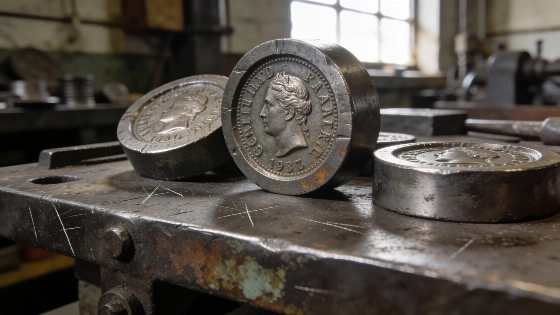
Every coin produced by the U.S. Mint in the 19th century began its life under immense pressure. Steel dies, engraved with the coin's designs, were forced against metal blanks to create each piece. The process demanded that these dies be both extremely hard to resist wear and tough enough to avoid breaking-a balance that proved difficult to achieve with the metallurgy of the era.
Coin dies that were too soft would deform, a problem known as "sinking," while those made too hard risked cracking under repeated use. The challenge for Mint technicians was to find a precise middle ground, ensuring each die could withstand thousands of strikes without failing prematurely.
Engineering the Right Steel Properties
Modern metallurgists describe the ideal coin die as needing three key qualities: impact resistance (toughness), wear resistance (hardness), and structural integrity. In the 1870s, these properties were not easily controlled. The Philadelphia Mint and its counterparts relied on established heat-treatment techniques, but results varied, especially at facilities like the San Francisco Mint, which handled much of its own die preparation.
In January 1877, William Barber, then Engraver at the U.S. Mint, documented his approach to hardening and tempering coin dies. His method aimed to extend die life during a period of heavy coin production, including the Trade Dollar and, soon after, the Morgan Dollar. Barber's correspondence with Mint Superintendent James Pollock provides a rare window into the technical reasoning behind these processes.
Case Hardening and Tempering Techniques
Barber's process began with case hardening, specifically pack carburizing. Completed dies were packed in a mixture of bone ash and powdered charcoal-referred to as "bone dressing"-and sealed in a metal box with fire clay. The box was then heated for eight to ten hours at around 930°C (1,700°F). This allowed carbon to diffuse into the die's surface, creating a hardened outer layer while leaving the core with different mechanical properties. The carbon content of the treated surface typically reached 0.3% to 0.6%.
After heating, the die was rapidly quenched, with cool water directed first at the die face and then immersing the entire die. This produced a hard, carbon-rich exterior, but left the die at risk of being too brittle at the edges. To address this, Barber introduced a tempering step. Traditionally, dies were tempered by placing them face-down on a red-hot iron plate and watching for color changes on the polished shoulder-a visual cue for temperature and thus the degree of tempering. However, Barber found this method led to uneven heating, with the bottom of the die becoming softer than the top.
Innovations to Prevent Cracking and Sinking
Barber modified the quenching process by enlarging the water flow hole, allowing more of the die's length to be hardened. This reduced the risk of "sinking" but increased the chance of edge cracking. To counteract this, he developed a new tempering technique: instead of heating from below, he used two red-hot iron half-rings to surround the die's circumference. This allowed heat to move inward from the edges, softening the outermost, most brittle areas while keeping the center hard. The result was a die with a tough, supportive collar around a hard core, better able to withstand the mechanical stresses of coin production.
Barber's approach required significant skill and judgment. Factors such as steel composition, furnace temperature, quenching speed, and the worker's ability to interpret temper colors all influenced the outcome. Even small variations could lead to large differences in die performance and lifespan.
Standardization and Lasting Impact
By the 1890s, the U.S. Mint began using steel with more consistent composition, simplifying the hardening and tempering process. According to historical records, the standardized die steel contained approximately 0.97% carbon, 0.21% silicon, 0.18% manganese, and trace amounts of phosphorus and sulfur, with the remainder being iron. This shift allowed for more predictable results and longer-lasting dies, reducing the reliance on individual worker skill.
For collectors and historians, Barber's 1877 letter is significant because it documents the Mint's efforts to push the limits of available technology. The physical evidence left on coins-such as die cracks, cuds, and signs of sinking-reflects the success or failure of these methods. Barber's innovations helped shape the reliability of U.S. coinage during a period of rapid expansion and heavy demand.
In 1877, the U.S. Mint produced millions of coins, including Trade Dollars and minor denominations, requiring hundreds of working dies. The need for durable dies was especially acute as Congress prepared to reintroduce the standard silver dollar in 1878, leading to the Morgan Dollar's debut. The technical improvements described by Barber contributed directly to the Mint's ability to meet these production targets.
Understanding the balance between hardness and toughness in coin dies highlights a broader principle in metallurgy: maximizing one property often comes at the expense of another. In Barber's era, achieving the right combination required not only technical knowledge but also careful observation and adaptation. The evolution of die steel and heat-treatment methods at the U.S. Mint illustrates how incremental improvements in materials and processes can have lasting effects on currency production and reliability.