The 1892-O Barber Half Dollar Micro O is one of the rarest and most sought-after U.S. coin varieties, combining a first-year minting error with extreme scarcity in high grades. Its story reveals how mint mistakes can shape currency history.
The 1892-O Barber Half Dollar Micro O stands as one of the most significant and elusive coin varieties in United States currency history. Minted at the New Orleans Mint in 1892, this coin is renowned not only for its first-year status in the Barber half dollar series but also for a dramatic mintmark error that has made it a legend among collectors. The Micro O variety was created when a mint worker mistakenly used a mintmark punch intended for a quarter dollar, resulting in an unusually small 'O' beneath the eagle's tail on the coin's reverse. This subtle but striking error was recognized by numismatists almost immediately after the coin entered circulation, and its rarity was noted as early as 1893.
Despite the initial interest in the new Barber half dollar design, very few Micro O coins were produced, and even fewer survived in collectible condition. Over time, the variety was largely overlooked in mainstream coin guides, which contributed to its scarcity, especially in higher grades. According to PCGS CoinFacts, fewer than 100 examples are believed to exist today, with most showing heavy circulation wear and grading only About Good (AG) to Very Good (VG). Mint State specimens are exceptionally rare, and their appearance at auction is a major event in the numismatic world.
Among the handful of Mint State coins, two stand out: the PCGS/CAC MS68 Eliasberg-Friend specimen and the PCGS/CAC MS67 Larry H. Miller specimen. The MS68 coin, which once belonged to the Eliasberg and Dale Friend collections, is considered the finest known example and last sold publicly in May 2022 for $199,750. The MS67 coin, from the Larry H. Miller Collection, realized $132,000 at auction in December 2020. Both coins are celebrated for their exceptional preservation, strike quality, and provenance, making them the ultimate trophies for advanced collectors.
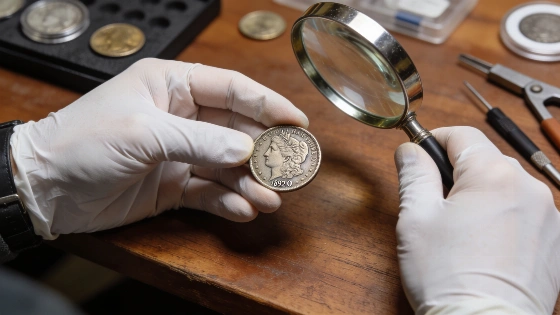
Collectors can identify the Micro O by its distinctly undersized mintmark, which is positioned beneath the eagle's tail feathers and above the 'D' in DOLLAR. The mintmark is noticeably smaller and lighter than the standard 'O' used on other 1892-O half dollars, occupying less than half the usual space. Once seen, the Micro O is unmistakable and has become a defining feature for specialists in the Barber half dollar series.
Facts and Data
The 1892-O Barber Half Dollar Micro O was produced at the New Orleans Mint in 1892, with fewer than 100 examples estimated to survive today. The finest known specimen, graded PCGS MS68, sold for $199,750 in May 2022, while the next highest-graded example, PCGS MS67, sold for $132,000 in December 2020. Most surviving coins are heavily circulated, with only a handful in Mint State condition.
Technical Details
The Barber half dollar was designed by Charles E. Barber and struck in 90% silver and 10% copper, weighing 12.50 grams with a diameter of 30.6 mm and a reeded edge. The Micro O variety is defined by its quarter-dollar-sized mintmark, a result of the minting error at the New Orleans facility.
Market and Collecting Impact
Any 1892-O Micro O half dollar is considered a major prize, with even low-grade examples commanding strong five-figure prices. The rarity and historical significance of the Micro O have made it a central focus for Barber half dollar specialists and trophy hunters alike. The MS68 specimen is regarded as a once-in-a-generation opportunity, while the MS67 coin is the most attainable for advanced collectors seeking a top-tier example.
The Micro O's combination of first-year issue, mintmark error, and extreme rarity in high grades has elevated it from a simple minting mistake to a symbol of numismatic achievement. Its story illustrates how small details and production errors can have lasting effects on the history and value of currency.
The Micro O variety also highlights the importance of mintmark placement and die usage in U.S. coinage. Mintmarks were originally intended to identify the facility where a coin was produced, but errors like the Micro O demonstrate how human oversight and equipment mix-ups could create lasting rarities. Today, collectors and researchers study these varieties not only for their market value but also for the insight they provide into the minting process and the evolution of U.S. coinage standards. The Micro O remains a benchmark for condition rarity and a testament to the enduring appeal of numismatic discovery.