
The 1851 Augustus Humbert $50 gold slug, a rare coin from California's Gold Rush, bridged the gap between raw gold and trusted money. Its story reveals how early Californians turned gold dust into a functioning currency system
In the early 1850s, California's gold fields produced immense wealth, but the region's monetary system lagged far behind. Gold dust was plentiful, yet there was no reliable way to convert it into trusted, standardized money. Miners and merchants faced daily challenges weighing gold dust, assessing its purity, and negotiating its value-an inefficient process that slowed commerce and left room for disputes and fraud.
To address this, the United States government authorized a federal assay office in San Francisco. Moffat & Co., a leading private gold firm, secured the contract, and Augustus Humbert, a skilled watchcase maker from New York, was appointed as United States Assayer of Gold. Humbert arrived in San Francisco in January 1851, bringing with him the tools and expertise needed to transform California's raw gold into a form that could circulate as money.
The Birth of the $50 Gold Slug
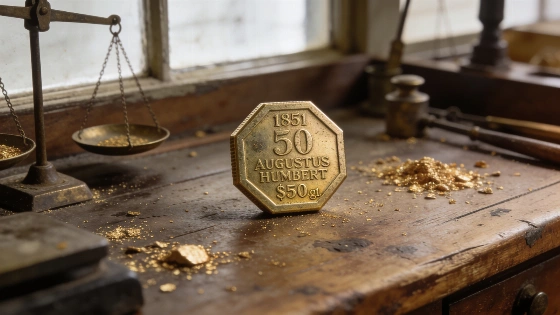
On January 31, 1851, Moffat & Co. produced the first octagonal $50 gold pieces under Humbert's supervision. These coins, known as "slugs," were massive by coin standards-nearly 2.5 ounces each-and carried a stated value and gold fineness. The earliest variety, known as Kagin-2, featured a lettered edge reading "AUGUSTUS HUMBERT UNITED STATES ASSAYER OF GOLD CALIFORNIA 1851."
The $50 slug was not a conventional coin but a federal assay ingot, stamped with its gold content and value. It was accepted by banks, merchants, and federal offices for payments, including customs duties. This gave California's gold a practical, trusted form, allowing the region's economy to function more efficiently during the Gold Rush.
According to numismatic research, the Kagin-2 variety is distinguished by its .880 fineness (88% gold) and the absence of a hand-punched "50" on the reverse. The elaborate engine-turned reverse design, reminiscent of watchcase decoration, reflects Humbert's background in precision metalwork. The obverse features a powerful eagle, attributed to medalist Charles Cushing Wright, symbolizing federal authority.
Production Challenges and Rarity
Producing the lettered-edge slugs was labor-intensive. Each piece required striking the obverse and reverse, stamping lettering on all eight edges, and punching in the gold fineness and denomination. This complexity led to frequent production flaws and edge damage, prompting the Assay Office to later switch to a simpler reeded edge.
Humbert's slugs were tailored to the variable purity of California gold. Pieces marked "880 THOUS." contained 88% gold, with the total weight adjusted to ensure each coin held $50 worth of gold at the time. Later issues increased the fineness to .900, aligning with federal coinage standards, but the early slugs remain a direct link to the realities of Gold Rush mining.
Estimates suggest that about 100 examples of the Kagin-2 lettered-edge variety survive today. Many show heavy wear, repairs, or edge damage, and only a small number are in high grades. For example, population reports indicate just 15 to 20 Mint State examples, with even fewer approved by third-party grading services for quality.
The Litman Specimen at Auction
One notable example from the Charles "Cheech" Litman Collection will be offered as Lot 2614 in Stack's Bowers Summer 2026 Global Showcase Auction. Graded AU-53 by NGC and approved by CAC and CMQ, this coin stands out for its strong detail, warm golden color, and unusually clean edges. While not Mint State, its combination of luster, sharpness, and preservation places it among the more desirable surviving slugs.
Recent auction results highlight the rarity and demand for these coins. Since 2021, Stack's Bowers has offered only two finer .880-fine lettered-edge slugs, with prices ranging from $81,000 to $360,000 depending on grade and provenance. Mint State examples have not appeared at auction since 2006, underscoring the scarcity of high-quality pieces.
Key specifications for the 1851 Augustus Humbert $50 slug include its octagonal shape, lettered edge, .880 gold fineness, and approximate weight of nearly 2.5 ounces. The coin's design and production reflect both the technical challenges and the ambition of Gold Rush California to create a trusted monetary system from raw gold.
Historical Impact and Legacy
The introduction of the $50 slug marked a turning point in California's monetary history. By providing a standardized, federally recognized form of gold money, the slugs enabled smoother trade, reduced disputes, and helped integrate California's economy with the rest of the United States. Their physical presence-large, heavy, and visually striking-made them a symbol of the era's ambition and resourcefulness.
While the slugs were eventually replaced by more conventional coins as the San Francisco Mint opened and federal coinage standards took hold, their legacy endures among collectors and historians. The surviving examples, especially those in high grades, are valued not only for their rarity but for their role in shaping the monetary landscape of the American West.
Numismatic records indicate that the Kagin-2 variety is the most available of the lettered-edge Humbert slugs, but even so, attractive circulated examples remain difficult to find. The Litman specimen's appearance at auction offers collectors a rare opportunity to acquire a piece of Gold Rush history that helped turn California's gold dust into trusted money.
The $50 slug's story illustrates how monetary innovation can emerge from necessity. In the absence of a federal mint, private firms and government contracts combined to create a practical solution for a rapidly growing economy. The slugs' design, production, and acceptance reveal the interplay between technical skill, regulatory authority, and the demands of commerce in a frontier environment.