
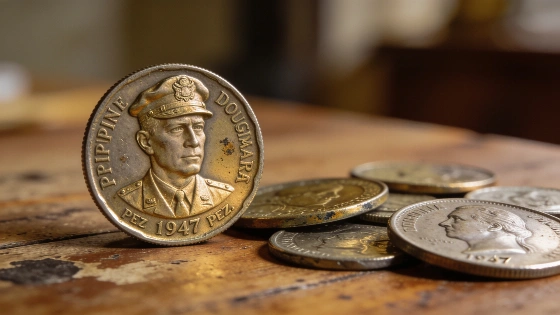
The 1947 Philippine peso and fifty centavos coins, featuring Gen. Douglas MacArthur, marked a rare tribute to a living foreign figure and reflected the nation's wartime history, postwar identity, and evolving currency design
When the Republic of the Philippines issued its first coins as an independent nation in 1947, the choice of Gen. Douglas MacArthur's portrait on the peso and fifty centavos was both a political and historical statement. MacArthur, the American general whose leadership during World War II and famous pledge to return made him a symbol of resistance and liberation, was honored on the obverse of these silver coins. His image, in military uniform and officer's cap, was surrounded by the inscription "DEFENDER AND LIBERATOR OF THE PHILIPPINES," while the reverse displayed the newly modified Philippine arms and the national flower, sampaguita.
This commemorative issue was unusual for several reasons. It was among the few times a living American appeared on a coin outside the United States, and it reflected the Philippines' complex relationship with its former colonial power. The coins were minted at the San Francisco Mint, with a limited run of 100,000 pesos and 200,000 fifty centavos. The peso measured 36 millimeters in diameter and weighed 20 grams, while the fifty centavos was 27 millimeters and 10 grams. Both coins had silver content-.800 for the peso and .750 for the fifty centavos-matching earlier standards from the U.S. administration period.
MacArthur's Role in Philippine Wartime History
MacArthur's connection to the Philippines began long before World War II. After serving as U.S. Army Chief of Staff, he was appointed Field Marshal of the Philippine Commonwealth's armed forces in the 1930s. As tensions with Japan escalated, he was tasked with commanding all U.S. Army troops in the islands. When Japan attacked in December 1941, MacArthur's forces, including both American and Filipino soldiers, retreated to the Bataan Peninsula and Corregidor Island, holding out for months despite severe shortages of food and medicine. The defenders' resistance delayed Japanese advances in Southeast Asia, but ultimately, the garrisons fell in April and May 1942.
Ordered to evacuate to Australia in March 1942, MacArthur famously declared, "I Shall Return," a promise that became a rallying cry for both Filipinos and Americans. During the occupation, this slogan circulated through broadcasts, leaflets, and even smuggled supplies. MacArthur's return to the Philippines began with the Leyte landings in October 1944, culminating in the liberation of Manila in early 1945. His leadership during these campaigns cemented his status as a national hero in the Philippines, even as his legacy remained complex and sometimes controversial in the United States.
Commemorative Coins and Their Legacy
The 1947 MacArthur coins were not only a tribute to a living figure but also a reflection of the Philippines' efforts to define its postwar identity. The coins' design, while not considered artistically outstanding, was distinctive for its historical resonance. Many pieces were acquired by collectors in the United States, and their relatively high survival rate has kept prices accessible for numismatists. According to Numismatic News, the coins' limited mintage and commemorative nature set them apart from regular circulation issues.
At the time of their release, MacArthur was overseeing the U.S. occupation of Japan, guiding the country's transition from militarism to democracy. The coins thus captured a moment when the Philippines sought to honor both its wartime suffering and its aspirations for the future. The MacArthur peso was the first of its kind struck by the U.S. Mint since 1912, and the fifty centavos matched the size of earlier Philippine issues. While the coins' design was sometimes criticized for lack of detail, their historical significance outweighed aesthetic concerns.
For collectors and historians, the MacArthur coins offer a tangible link to a pivotal era. Their issuance followed a tradition of commemorative coinage, such as the 1936 Commonwealth set featuring President Quezon and Governor General Murphy. The practice of honoring living individuals on coins remains rare, making the 1947 series notable in both Philippine and international numismatic history. For those interested in other significant U.S. coin issues, the story of the 1939 Proof Walking Liberty Half Dollar's record-setting auction provides further insight into how rarity and preservation shape collector interest: see this analysis of a landmark U.S. half dollar sale.
Facts and Figures: Mintage and Specifications
The 1947 MacArthur peso had a mintage of 100,000 pieces, while the fifty centavos saw 200,000 struck, all at the San Francisco Mint. The peso's diameter was 36 mm and weight 20 grams, with a silver fineness of .800. The fifty centavos measured 27 mm, weighed 10 grams, and had a fineness of .750. These specifications closely followed earlier U.S.-era Philippine coinage standards. Despite being legal tender, many coins were saved as souvenirs or collectibles, limiting their actual circulation.
Today, the MacArthur coins are valued more for their historical context than for their silver content or rarity. Their presence in both Philippine and American collections reflects the enduring legacy of wartime alliances and the symbolic power of currency design in shaping national memory.
The issuance of commemorative coins often raises questions about the distinction between circulating and non-circulating legal tender. In the case of the 1947 MacArthur coins, their status as legal tender was clear, but their primary function was commemorative. This dual role is not unique to the Philippines; many countries have issued coins intended more for collectors or as national symbols than for everyday transactions. The decision to feature a living foreign figure also highlights the intersection of politics, diplomacy, and monetary design, illustrating how coins can serve as instruments of both memory and statecraft.