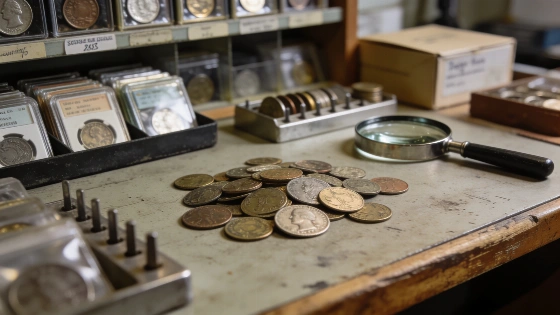
Coin dealing is not taught in universities or through official apprenticeships. Instead, collectors and business professionals often find their way into the trade through family ties, personal passion, or unexpected opportunities
Coin dealing is one of the few professions in the financial world where no formal degree, certification, or apprenticeship is required. Yet the path to becoming a coin dealer is rarely straightforward-and for many, it is shaped by chance encounters, family traditions, or a collector's obsession that refuses to fade.
For some, the journey begins in childhood, growing up in families where coins are more than pocket change. Others arrive later, after years spent in unrelated careers, drawn by the lure of rare metals and the challenge of valuation. There are even those who inherit vast collections and become dealers out of necessity, learning the trade as they go in order to maximize the value of what they sell.
From Collector to Dealer
Patrick A. Heller's story defies the usual script. He did not inherit a coin shop or stumble into the business through a family connection. Instead, his interest was sparked in 1964, when the Kennedy Half Dollar ignited a nationwide surge in coin collecting. The real turning point came a few years later, when a magazine article profiled a teenage dealer named Robert E. Ladum. That brief story planted the idea that coin dealing could be a real career, even if it seemed unconventional at the time.
Despite this early inspiration, Heller initially pursued a more traditional path, earning a business administration degree and working as a certified public accountant. But proximity to Liberty Coin Service, a shop near Michigan State University, changed everything. After befriending the founder, R. W. "Bill" Bradford, Heller was eventually offered the chance to buy the business. He declined at first, but after months of persuasion-and a critical intervention in a proposed buyout-he took over the shop in 1980, just as the bullion boom was ending and the market was turning difficult.
Surviving the Volatile 1980s
The early 1980s were a punishing time for coin dealers. The collapse of the bullion market forced many out of the business, and only those with deep knowledge, adaptability, or sheer persistence survived. Heller managed to keep Liberty Coin Service afloat, eventually selling the business in 2015 but continuing to work there in a new capacity. His career demonstrates that success in coin dealing is less about formal credentials and more about timing, relationships, and the ability to navigate unpredictable markets.
Coin dealing remains a field where personal reputation and expertise matter more than diplomas. Dealers must be able to authenticate coins, assess condition, and understand both collector demand and bullion value. The absence of formal training programs means that most learning happens on the job, through mentorship, or by absorbing knowledge from industry veterans. As seen in the reported earlier recognition of innovative coin designs, the field continues to evolve, rewarding those who stay engaged with both history and current trends.
Numismatic Knowledge and Industry Recognition
Heller's expertise has been recognized with multiple awards from the American Numismatic Association and other industry groups. He now serves as communications officer for Liberty Coin Service and volunteers as an Industry Issues Advisor for the National Coin & Bullion Association. His experience highlights the importance of ongoing education and community involvement in a profession where trust and credibility are paramount.
According to historical records, George T. Morgan-the designer of the Morgan Dollar-received his training in England at the National Art Training School before working as a die engraver. His eventual appointment as Chief Engraver at the U.S. Mint in 1917 was the result of both skill and circumstance, illustrating how numismatic careers often depend on a mix of talent, opportunity, and timing.
In the United States, there are no official statistics on the number of active coin dealers, but industry associations estimate that thousands operate nationwide, ranging from small part-time sellers to major retail operations. The market's size fluctuates with bullion prices, collector interest, and broader economic trends. For example, the 1979-1980 bullion boom saw a surge in new dealers, followed by a sharp contraction as prices fell. Surviving such cycles requires not only expertise in coins but also a keen sense of business risk and adaptability.
While the profession lacks formal entry barriers, it is not without risks. Dealers must guard against counterfeits, market volatility, and shifting consumer preferences. The absence of standardized training means that mistakes can be costly, both financially and reputationally. Yet for those who persist, coin dealing offers a unique blend of history, commerce, and personal challenge-one that continues to attract new entrants, often from the most unexpected backgrounds.
Numismatics is more than a hobby or a business; it is a field where history, art, and economics intersect. The lack of formal pathways into coin dealing has not diminished its appeal. Instead, it has fostered a culture of mentorship, self-education, and community recognition. As the industry evolves, those who succeed will be the ones who combine technical skill with adaptability and a genuine passion for the subject. The next generation of coin dealers may be inspired by a family collection, a chance encounter, or even a single article-just as Heller was decades ago.
The term "cent" in American currency traces its roots to the Latin word "centum," meaning one hundred. In the context of U.S. coinage, a cent represents one one-hundredth of a dollar, reflecting the decimal structure adopted by the United States in the late 18th century. This system distinguished the U.S. from many European countries that used non-decimal subdivisions, and it remains a defining feature of American money today.