A landmark collection of rare American coins, assembled by Denis W. Loring and Donna Levin, will be sold at Heritage's 2027 FUN Convention, offering collectors a unique chance to acquire pieces spanning early copper, Colonial silver, and Buffalo nickel errors
The Loring-Levin Collection, a significant private assembly of rare American coins, is set to be auctioned by Heritage Auctions at the 2027 FUN U.S. Coins Signature® Auction, scheduled for January 12-16, 2027. The collection, consigned by Denis W. Loring and Donna Levin, will be offered without reserve, ensuring that every lot will be sold to the highest bidder. Additional selections from the collection are expected to appear in Heritage's Showcase Auctions in early 2027, broadening access for collectors and institutions interested in American numismatic history.
This collection stands out not only for its breadth but also for the expertise and dedication of its creators. Denis W. Loring, an early member of the Early American Coppers (EAC) organization since its founding in 1967, is recognized for his decades-long research into early American large cents, particularly Proof issues and their pedigrees. Donna Levin, who joined EAC in 1998, developed a specialty in Buffalo nickel mint errors, adding a distinctive dimension to the collection. Both collectors have contributed to numismatic scholarship, with Loring serving in EAC leadership for 46 years and Levin acting as secretary from 2017 to 2023.
Rare Coins and Historical Highlights
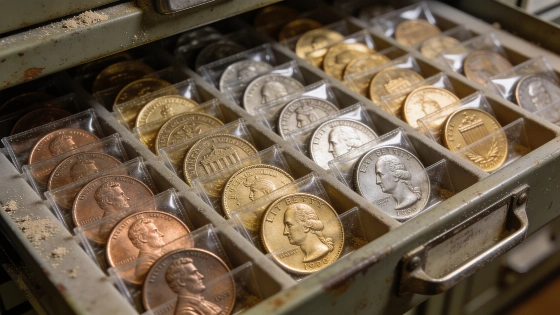
The Loring-Levin Collection encompasses a wide range of American coinage, including early copper coins, Colonial silver, 1792 pattern pieces, classic U.S. gold, Territorial gold, and notable Buffalo nickel errors. Among the most significant coins are the 1792 Judd-5 Birch Cent (graded Fair 2), one of only two known examples, and the 1854-S Quarter Eagle (Fine 12), a Gold Rush-era rarity with a mintage of just 246 pieces. Other highlights include a 1793 Sheldon-13 Liberty Cap Cent (AU53 NGC), a (1652) NE Shilling (AU50 PCGS), and a 1794 Silver Dollar (VF25, formerly PCGS).
The collection also features remarkable error coins, such as a 1919 Buffalo Nickel struck on a cent planchet (MS64 Brown PCGS) and a 1920 Buffalo Nickel struck on a dime planchet (AU55 PCGS), reflecting Levin's focus on minting anomalies. These pieces illustrate the technical and historical diversity of U.S. coin production, offering collectors a rare opportunity to acquire coins that seldom appear at public auction.
Numismatic Legacy and Market Context
The decision to auction the Loring-Levin Collection without reserve is expected to attract strong interest from collectors and institutions. In recent years, major U.S. coin auctions have seen heightened demand for rare and historically significant pieces, with several headline coins achieving record prices. For example, Heritage's previous auctions have included collections of Latin American and Spanish coins that drew international attention, as seen in the coverage of the Grundy Collection at the ANA World & Ancient Coins Auction (see this related report).
According to Heritage Auctions, the Loring-Levin Collection's cross-section of early American coinage and error coins is expected to appeal to both advanced collectors and those seeking to enter the market. The absence of reserves means that final prices will be determined solely by bidder demand, a factor that can lead to both competitive bidding and the discovery of new market benchmarks for rare types.
Facts and Figures
The 1854-S Quarter Eagle, one of the collection's highlights, is notable for its extremely low mintage of 246 coins, with only a small number known to survive today. The 1792 Judd-5 Birch Cent is even rarer, with just two confirmed examples. Auction records for similar rarities have shown strong appreciation in recent years, with early American pattern coins and Gold Rush-era issues often exceeding pre-sale estimates. The inclusion of error coins, such as Buffalo nickels struck on wrong planchets, reflects a growing segment of the numismatic market, where unique minting errors can command significant premiums over standard issues.
Understanding Numismatic Auctions Without Reserve
In numismatic auctions, a "no reserve" sale means that every lot will be sold regardless of the final bid, with no minimum price set by the consignor. This approach can increase bidder participation and price discovery, as collectors know that each coin will change hands at the close of bidding. While this can sometimes result in bargains for buyers, it also introduces uncertainty for sellers, who must accept the market's valuation. For historically significant collections like the Loring-Levin, the absence of reserves often signals confidence in the collection's appeal and the auction house's ability to attract a global audience of bidders.