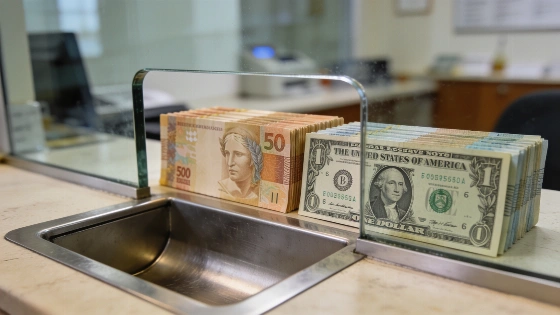
Goldman Sachs now expects the US dollar to remain stronger against the Brazilian real in the coming months, citing heightened political uncertainty ahead of Brazil's election and the need for fiscal clarity before any sustained real recovery
Goldman Sachs has revised its outlook for the US dollar to Brazilian real exchange rate, projecting a weaker real in the near term as Brazil's upcoming election injects fresh political risk into currency markets. The bank now expects the USD/BRL rate to stand at 5.20 in three months, 5.10 in six months, and 5.00 in twelve months, reflecting a shift from its earlier, more optimistic view of the real's short-term prospects.
Previously, Goldman Sachs had forecasted the USD/BRL at 4.90 in three months and 5.00 in six and twelve months. The updated projections indicate that the bank no longer anticipates a near-term appreciation of the real, instead signaling a period of modest weakness before a gradual recovery. According to the bank, the adjustment is driven by the return of political risk premiums as Brazil approaches its national election, with the real's performance now seen as closely tied to evolving expectations about fiscal policy and the outcome of the vote.
Political Uncertainty Drives Currency Outlook
The revised forecast comes as the spot USD/BRL rate hovered near 5.19 at the time of the report, suggesting that Goldman Sachs' new three-month target essentially removes any expectation of immediate real gains. The bank emphasizes that this is not a wholesale negative turn on the real, but rather a recognition that political uncertainty is likely to dominate in the short term. The real could still experience tactical rallies, but Goldman Sachs argues that a sustained move below 5.00 against the dollar is unlikely without clearer commitments to fiscal consolidation after the election.
In its analysis, the bank notes that the exchange rate will remain sensitive to shifting probabilities for the leading candidates and to market perceptions of their fiscal plans. The 5.00 level is identified as both the twelve-month target and a threshold that may prove difficult to break unless post-election fiscal policy becomes more transparent and credible. This view echoes broader market concerns that political events can temporarily override economic fundamentals, especially in emerging markets.
Carry Trade Potential and Medium-Term Prospects
Despite the near-term caution, Goldman Sachs maintains that high-yielding currencies like the Brazilian real could regain support once the immediate political premium fades. The bank's medium-term trajectory for USD/BRL slopes lower, reflecting expectations that Brazil's relatively high interest rates will eventually attract capital back to the real, provided that political risks subside and fiscal policy stabilizes. However, the bank warns that different election outcomes could still disrupt this path, underscoring the conditional nature of its forecast.
For context, the USD/BRL exchange rate has experienced significant volatility in recent years, often reacting sharply to shifts in domestic politics, global risk appetite, and changes in Brazil's fiscal outlook. As of the latest update, Goldman Sachs' forecast implies a modest depreciation of the real in the coming months, followed by a gradual appreciation if fiscal clarity emerges. This pattern is consistent with broader trends in emerging-market currencies, where political cycles and policy credibility play a decisive role in shaping exchange-rate dynamics.
Comparing Global Currency Risks
Brazil's situation is not unique among major emerging markets, where elections and fiscal policy debates frequently drive currency volatility. For example, the euro and US dollar have also faced periods of heightened uncertainty due to shifting central bank expectations and geopolitical risks, as discussed in our recent analysis of prolonged euro-dollar volatility amid changing Federal Reserve policy bets. In each case, the interplay between political events and economic fundamentals can lead to rapid changes in currency direction, making forecasts especially sensitive to new developments.
According to data from Goldman Sachs, the USD/BRL spot rate was approximately 5.19 at the time of the forecast revision. The bank's new projections-5.20 in three months, 5.10 in six months, and 5.00 in twelve months-reflect a more cautious stance on the real's ability to strengthen before Brazil's election outcome and subsequent fiscal policy become clearer. The previous forecast had anticipated a stronger real in the near term, but this has now been adjusted to account for the increased political risk premium.
Political risk premiums are a recurring feature in currency markets, especially in countries where elections can lead to significant policy shifts. In Brazil, the real's sensitivity to fiscal policy announcements and election outcomes has been particularly pronounced, with investors closely monitoring signals about future government spending, debt management, and structural reforms. Until there is greater clarity on these issues, the real is likely to remain under pressure, with any sustained appreciation dependent on credible fiscal consolidation measures after the election.
Political risk premiums refer to the additional compensation investors demand for holding assets in countries where political events could disrupt economic policy or financial stability. In currency markets, this often translates into higher volatility and weaker exchange rates ahead of elections or major policy decisions. For the Brazilian real, the size of the risk premium can fluctuate rapidly as new information emerges about candidates' fiscal plans or the likelihood of policy continuity. This dynamic makes it challenging to forecast the real's path with precision, especially during periods of heightened uncertainty.