
Obsolete paper money from Eufaula, Indian Territory, reveals a unique blend of local rivalry, family connections, and the evolution of private scrip in the late 19th and early 20th centuries
Collectors of obsolete paper money often find notes from eastern U.S. states such as Georgia, New York, Pennsylvania, and South Carolina relatively accessible. In contrast, acquiring authentic obsolete notes from the American West, and especially from Indian Territory, presents a greater challenge. While some collectors settle for related fiscal instruments like checks or warrants, true banknotes from this region remain rare and highly sought after.
One notable series of obsolete scrip emerged in Eufaula, Indian Territory, around the turn of the 20th century. Eufaula, located in what is now east-central Oklahoma, was incorporated in 1898 and became the county seat of McIntosh County after a period of intense local rivalry. The contest with neighboring Checotah was so fierce that it included an armed attempt to seize county records, which Eufaula's residents successfully resisted. According to the 1900 U.S. federal census, Eufaula had a population of 757, reflecting its modest but growing status at the time.
Patterson-Foley and the Rise of Local Scrip
The story of Eufaula's scrip is closely tied to the town's early mercantile partnerships. Emmet Foley arrived in Eufaula in 1881, shortly after the railroad's arrival spurred local development. He joined a business partnership known as Patterson & Foley, which played a central role in the town's commercial life. In 1889, Charles Henry Tully moved to Eufaula, initially working as a schoolteacher before becoming a clerk for Foley in 1891. The original partnership dissolved in 1891-92, and Tully became Foley's new partner in the rebranded Foley & Tully mercantile store, as confirmed by period advertisements from 1892.
By early 1898, Foley decided to leave the partnership to establish the Foley Banking Company, which opened on February 28, 1898. Tully continued the mercantile business, first under his own name and, from January 1902, as the C.H. Tully Mercantile Company. Tully eventually sold the business in 1907 to pursue a legal career, practicing law until his death in 1933. These transitions were reflected in the scrip issued by the business, which documented changes in ownership and company name over time.
Family Portraits on Private Currency
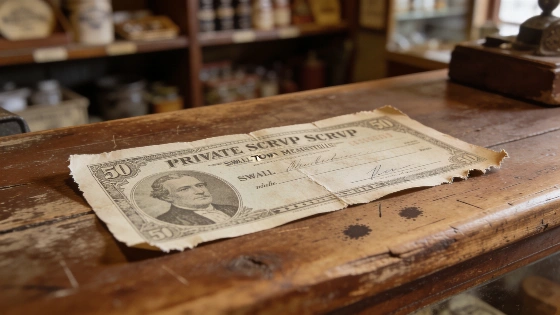
The scrip issued by Foley & Tully and later by C.H. Tully Mercantile Company is notable for its personal touches. Early notes featured a portrait of Katie Foley, who was both Emmet Foley's sister and Charles Tully's wife. The couple married in July 1890, and by 1892, Tully had become Foley's business partner. In October 1899, Charles and Katie Tully welcomed their daughter, Naomi. In 1903, a new issue of scrip appeared featuring a vignette of young Naomi Tully, then about three or four years old. This practice of placing family members' portraits on private scrip was not uncommon in the era, but the Eufaula notes stand out for their clear documentation of family and business ties.
These scrip issues serve as both historical artifacts and numismatic curiosities, offering insight into the ways local businesses in Indian Territory used private currency to facilitate trade and reinforce community identity. The notes also reflect the close-knit nature of business and family life in small frontier towns, where personal relationships often shaped economic activity.
Documenting a Local Currency Legacy
According to a report from The Numismatist, the final issue of C.H. Tully Mercantile Company scrip, released in 1903, featured a vignette of Naomi Tully. The scrip's evolution-from Patterson & Foley to Foley & Tully, and finally to C.H. Tully Mercantile Company-mirrors the shifting landscape of local commerce in Eufaula during a period of rapid change. These notes are now rare collectibles, valued for their historical context as much as their design.
While precise figures on surviving Eufaula scrip are limited, the notes' scarcity is well established among collectors. Most known examples date from the 1890s to the early 1900s, with the final issues appearing just before Oklahoma achieved statehood in 1907. The transition from private scrip to standardized national currency marked the end of an era for local issuers like the Tully family, whose notes now serve as tangible reminders of a formative period in regional monetary history.
Private scrip, such as that issued in Eufaula, played a crucial role in local economies before the widespread adoption of federally issued currency. These notes were typically redeemable at the issuing business and relied on the reputation and solvency of the issuer. While not legal tender, they functioned as a practical medium of exchange in communities where official currency was scarce or difficult to obtain. The practice of featuring family members on scrip highlights the personal nature of these instruments and the intertwining of business, family, and community in the economic life of frontier towns.