Issued after the Civil War, National Gold Bank Notes from California offered a gold-backed alternative to paper money, combining strict redemption promises with some of the most distinctive designs in U.S. currency history
In the aftermath of the U.S. Civil War, the country's monetary system faced deep uncertainty. The widespread use of "greenbacks"-paper notes not backed by gold-sparked inflation fears and eroded public trust, especially in California, where a preference for hard money was deeply rooted. To address these concerns, Congress enacted the National Gold Bank Act as part of the Currency Act of July 12, 1870, authorizing a select group of banks-primarily in California-to issue National Gold Bank Notes. These notes were unique in that they could be redeemed strictly for gold coin, a feature designed to reassure a skeptical public.
Although their period of circulation was brief, National Gold Bank Notes have become some of the most coveted and visually striking large-size notes ever produced by the Bureau of Engraving and Printing. Their rarity and distinctive design continue to attract collectors and historians alike.
Origins and Purpose of Gold Bank Notes
Unlike standard National Bank Notes, which were backed by U.S. government bonds and redeemable in "lawful money," National Gold Bank Notes carried a clear promise: they could be exchanged for gold coin on demand. This was a critical distinction for Californians, who had long distrusted paper currency and demanded tangible guarantees of value. The solution was a note that not only stated its gold backing in bold terms but also incorporated visual and legal assurances of redemption.
Between 1871 and 1883, ten authorized National Gold Banks-nine in California and one that later moved to Boston-issued nearly 200,000 notes with a total face value of $3,465,240. Today, only a small fraction of these notes survive, making them among the rarest U.S. banknotes.
Issuers, Denominations, and Surviving Rarities
The ten chartered National Gold Banks included institutions in San Francisco, San Jose, Santa Barbara, Oakland, Petaluma, Stockton, Sacramento, and Boston. Most issued $5, $10, and $20 notes, while $50 and $100 denominations were produced in much smaller numbers. Although $500 notes were authorized, no examples are known to have survived or even circulated.
Fewer than 600 National Gold Bank Notes are known to exist across all denominations, with most surviving examples in heavily circulated condition. For instance, $5 notes from the Farmers National Gold Bank of San Jose are exceptionally scarce, and high-grade pieces are virtually unknown. At auction, a $5 note from the First National Gold Bank of San Francisco graded Extremely Fine 40 EPQ by PMG sold in March 2018 as part of the A.J. Vanderbilt Collection.
Among $10 notes, those from the First National Gold Bank of Petaluma are particularly rare, with only two or three believed to exist. In 2014, a PMG Fine-15 Petaluma $10 note sold for $126,500. The $20 notes from Santa Barbara are even more elusive, with only one or two known, likely held in institutional collections. High-denomination notes, such as the $50 from the California National Gold Bank of San Francisco, are among the rarest large-size notes of the era, with just six known examples. In August 2018, a $50 note from this issuer sold for $384,000. The $100 notes are even scarcer, with a unique $100 Santa Barbara note selling for $282,000 in 2017. No $500 notes are known to exist.
Design and the Iconic Gold Coin Vignette
National Gold Bank Notes are celebrated for their artistry and distinctive features. Key design elements include prominent "Redeemable in Gold Coin" statements, gold-tinted Treasury seals, bank-specific titles and charter numbers, and vivid orange-yellow reverses that set them apart from the typical green of other national notes. The engraving quality was exceptionally high, with intricate borders and lifelike vignettes intended to inspire confidence in the note's value.
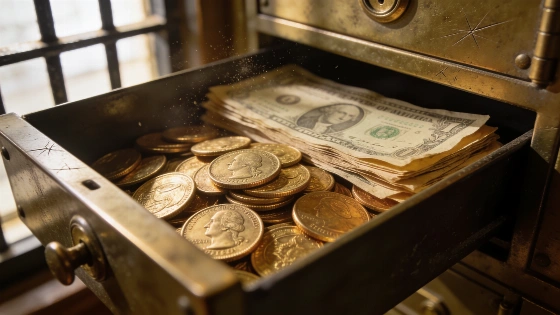
The most iconic feature is the reverse vignette, which depicts a detailed pile of U.S. gold coins. Unlike allegorical figures common on other notes, this engraving shows actual gold coins-$20 Liberty Head Double Eagles, $10 Eagles, $5 Half Eagles, $3 and $1 Indian Head gold coins, and $2.50 Quarter Eagles-arranged in a realistic, almost three-dimensional composition. This vignette, engraved by James Smillie, was exclusive to National Gold Bank Notes and served as a visual guarantee of the note's gold backing. Contrary to some claims, only gold coins are depicted; no silver denominations appear in the design.
Specimen sheets, such as the uncut $50 and $100 notes from the Kidder National Gold Bank, occasionally appear at auction and offer a rare glimpse into the production process. In 2025, an uncut specimen sheet from Kidder sold for $66,000 at a major U.S. currency auction.
Decline, Redemption, and Collector Value
By the late 1870s, maintaining gold redemption became increasingly difficult for issuing banks as federal monetary policy shifted toward uniformity and away from regional experiments. Many National Gold Bank Notes were redeemed and destroyed, while others simply disappeared from circulation. By the early 20th century, these notes had effectively vanished from everyday use.
Today, National Gold Bank Notes are highly prized by collectors for their rarity, historical significance, and artistic merit. Even heavily worn examples can command five-figure prices, while high-grade or rare-issuer notes often reach six figures at auction. The market for these notes remains strong, especially for unique or nearly unique pieces from issuers like Petaluma, Santa Barbara, and San Jose.
For those interested in the broader world of rare U.S. coins and currency, the record-setting sale of a 1939 Proof Walking Liberty Half Dollar, as covered in this feature on top-tier U.S. coin collecting, highlights the enduring appeal of American numismatic rarities.
Between 1871 and 1883, the ten National Gold Banks issued nearly 200,000 notes with a combined face value of $3,465,240. Today, fewer than 600 examples are known to survive across all denominations, with most grading Very Fine or lower. High-denomination notes, such as the $50 and $100, are among the rarest, with only a handful of specimens documented and auction prices regularly exceeding $200,000 for the finest pieces.
The National Gold Bank Note experiment stands as a unique chapter in U.S. currency history. It illustrates the tension between regional monetary preferences and national policy, as well as the lengths to which authorities went to restore public confidence in paper money. The notes' distinctive gold coin vignette remains a testament to the era's engraving artistry and the enduring power of visual guarantees in currency design.