
August 2026 auctions at four major US houses revealed that coins with CAC approval consistently sold for far more than similar non-CAC pieces, confirming the market's willingness to pay for independent quality verification
When a 1976-S silver Eisenhower dollar graded CACG MS68 hammered for $715 in August 2026, while non-CAC examples in the same grade struggled to break $150, the message was unmistakable: independent quality approval is now a decisive force in the US rare coin market. Collectors and dealers are not just noticing the CAC sticker-they are opening their wallets for it.
Across four of the country's most active auction houses-GreatCollections, David Lawrence Rare Coins, Heritage Auctions, and Stack's Bowers-CAC-approved and CACG-encapsulated coins repeatedly outperformed their non-CAC counterparts, sometimes by margins that defy traditional price guides. The August results were not isolated to a single denomination or era, but spanned coins from the early 19th century through the 1970s, covering everything from copper half cents to commemorative silver dollars.
Premiums That Redefine the Market
Some of the most striking price gaps emerged in direct head-to-head comparisons. At Stack's Bowers, two 1943 steel cents, both graded PCGS MS68, sold in consecutive lots. The CAC-approved coin realized $5,612, while the non-CAC example brought $2,684. Heritage Auctions saw a CAC-approved 1909 VDB Lincoln cent in PCGS MS67 Red fetch $4,636-over three times the price of similar non-CAC coins. Meanwhile, a CAC-approved 1858 Large Letters Flying Eagle cent soared to $14,030, more than double the $6,875 achieved by a comparable non-CAC piece just weeks earlier.
GreatCollections delivered a series of telling results. On August 2, a CACG MS68 1976-S silver Eisenhower dollar sold for $715, while three non-CAC PCGS MS68 examples offered later in the month failed to reach $150. A CACG MS67 1923 Peace dollar brought $6,600, nearly twice the price of recent non-CAC sales. Even in less dramatic cases, such as an 1832 half cent graded CACG AU58, the CAC premium was evident, with the coin selling for $425-above the non-CAC equivalent.
What Drives the CAC Premium?
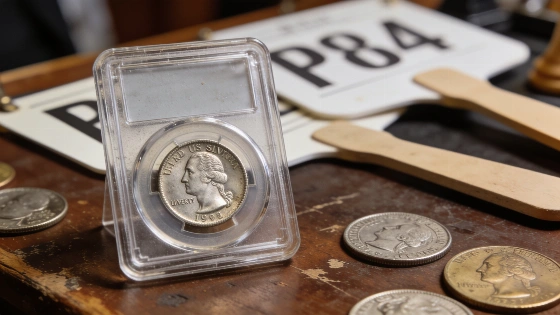
While numerical grades from PCGS and NGC remain the industry standard, the CAC sticker signals a second layer of scrutiny. CAC (Certified Acceptance Corporation) reviews coins already graded by major services and awards its sticker only to those meeting strict standards for eye appeal, strike, and originality. CACG encapsulation, introduced more recently, combines grading and approval in a single holder. For many buyers, this extra assurance justifies a significant premium, especially for coins where visual quality can vary widely within the same grade.
However, auction prices are never a controlled experiment. No two coins are identical, even at the same grade. Factors such as toning, luster, strike sharpness, provenance, and even the generation of the holder can all influence bidding. Auction timing and the intensity of competition also play a role. Yet the August 2026 pattern-across four major venues and a broad range of US coinage-points to a market-wide recognition of CAC's influence.
Data Points and Market Context
In August 2026, CAC-approved coins consistently outperformed non-CAC examples at public auction. For instance, the 1976-S silver Eisenhower dollar (40% silver, 24.59 g, 38.1 mm, 11 million minted) in CACG MS68 sold for $715, while non-CAC MS68s averaged under $150. A CAC-approved 1858 Large Letters Flying Eagle cent (88% copper, 12% nickel, 4.67 g, 19.0 mm, 24.6 million minted) realized $14,030, compared to $6,875 for a non-CAC coin. These results were mirrored across denominations and eras, from 19th-century three-cent nickels to 20th-century commemoratives.
David Lawrence Rare Coins added further evidence, with an 1869 Three-Cent Nickel graded CACG MS65 selling for $1,700-more than double the price of a non-CAC MS65. Even in proof issues, such as the 1883 Liberty Seated quarter and the 1895 Barber dime, CAC approval translated into higher realized prices. The pattern was clear: buyers are willing to pay for the added confidence that CAC provides.
Implications for Collectors and the Industry
The willingness of collectors to pay substantial premiums for CAC-approved coins is not just a matter of taste-it is a market reality that affects pricing, liquidity, and even the strategies of dealers and consignors. For sellers, CAC approval can mean the difference between a routine sale and a standout result. For buyers, it offers a form of risk mitigation in a market where visual quality and originality are paramount but not always obvious from a numerical grade alone.
This trend also intersects with broader developments in coin authentication and verification. As reported earlier, major online platforms are expanding third-party authentication for high-value coins, reflecting growing demand for independent verification in a market where counterfeits and overgraded coins remain a concern.
For now, the August 2026 auction season has made one thing clear: the CAC sticker is not just a marketing tool-it is a market force. Collectors who ignore it do so at their own financial risk. The numbers speak for themselves, and the premium is no longer theoretical. In a market where trust is currency, CAC approval has become a form of hard collateral.
While CAC's influence is most visible in the US rare coin market, the underlying principle-paying for independent verification-has implications for collectibles and currency markets worldwide. As authentication standards evolve and buyers demand greater transparency, the premium for trusted third-party review is likely to remain a fixture, not a fad.
Understanding Coin Grading and Approval
Coin grading assigns a numerical value to a coin's condition, typically on a 1-70 scale, with higher numbers indicating better preservation and eye appeal. Major grading services such as PCGS and NGC set the industry standard, but differences in strike, luster, and surface quality can exist even among coins with identical grades. CAC adds a further layer by certifying coins that meet its own criteria for quality within the assigned grade. This dual-layer system has reshaped how collectors and dealers assess value, making independent approval a key factor in both pricing and market confidence.