Atlas Numismatics has expanded its fixed-price list with 390 new coins, medals, and tokens, spanning over 2,000 years of monetary history and including rare gold, silver, and platinum pieces from Europe and the Americas
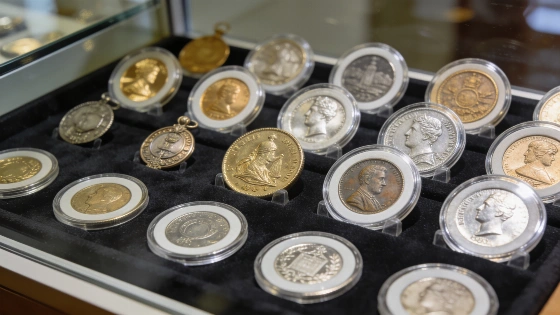
Atlas Numismatics has released a major update to its fixed-price list, introducing 390 additional coins, medals, and tokens to its online catalogue. The new selection covers more than two millennia of numismatic history, with items ranging from 18th-century gold coins to commemorative medals marking pivotal events in European and world history. The update reflects ongoing demand among collectors for rare and historically significant pieces, as well as the continued evolution of the global coin market.
Among the highlights is an 1854 Austrian silver gulden minted in Vienna to commemorate the wedding of Emperor Franz Joseph I and Elisabeth of Bavaria, known as "Sisi." This coin features the couple's conjoined portraits on the obverse and a depiction of their wedding vows on the reverse. Graded MS65 by PCGS, it weighs 12.96 grams and is listed at $2,250. The gulden is catalogued under KM X-M1 and Jaeger 299, and its preservation and historical context make it a sought-after item for collectors of imperial European coinage.
Notable Patterns and Gold Issues
The update also includes a rare 1791 French Constitutional Ecu pattern by François Vasselon, graded MS64 by NGC. This silver piece, notable for its plain edge and revolutionary symbolism, displays a left-facing bust of Louis XVI and the motto "REGNE DE LA LOI" ("Reign of the Law"). The reverse features a standing Genius inscribing "Constitution," with a rooster and a capped fasces as additional symbols. With references Mazard 84 and Gadoury 53, this coin is listed at $36,500 and is described as the finest certified example by NGC as of June 2026.
For collectors of German coinage, a 1703 gold 3-ducat piece from Nürnberg stands out as the most expensive item in the update, priced at $49,500. Issued during the reign of Holy Roman Emperor Leopold I, the coin is graded MS61 by PCGS and weighs 10.44 grams. Its obverse features three ribbon-bound shields, while the reverse depicts the Paschal Lamb with a banner marked "PAX" standing on a globe, surrounded by a Latin prayer for peace. The coin is referenced as KM 262, Kellner 46, and Friedberg 1880.
Commemorating Historic Events
One of the most historically resonant pieces is a large British silver medal marking the defeat of the Spanish Armada in 1588. Graded MS62 by PCGS, the medal measures 51.2 millimeters and weighs 45.30 grams. The obverse shows the Spanish Armada in battle, illuminated by the name of Jehovah, while the reverse depicts a church on a rocky island amid stormy seas. The medal, which is unsigned, is catalogued as Eimer 57, Medallic Illustrations 145/112, van Loon I 386,1, and Saunders-Vanhoudt 1588-13, and is offered at $44,500.
Another standout is an undated platinum medal from around 1953, produced by the Bavarian State Mint in Munich to mark the coronation of Queen Elizabeth II. Weighing nearly 100 grams and graded PR64 Cameo by PCGS, the medal features designs by T. H. Paget and Walter Leonhard. The obverse shows the Queen crowned, with a Latin inscription translating to "The love of the people is the safeguard of the Queen." The reverse arranges national floral emblems in a cruciform pattern. With a reported mintage of 3,000, Atlas Numismatics notes that platinum examples are exceptionally rare, listing this piece at $37,500.
Colonial Gold and Market Context
The collection also features a 1756 Lima Mint gold 8 Escudos coin from the reign of Ferdinand VI of Spain, graded MS61 by PCGS and weighing 27.01 grams. The obverse presents a right-facing bust of the king, while the reverse displays the crowned royal arms encircled by the Order's chain and the Latin motto "NOMINA MAGNA SEQUOR" ("I follow great names"). This coin is referenced as KM 59.1, Calicó 771, and Calicó Onza 584, and is listed at $22,500.
Atlas Numismatics' latest update comes as the global market for rare coins and medals continues to attract collectors seeking both historical significance and investment potential. According to the company, its online inventory is refreshed monthly, and collectors can subscribe to a newsletter for updates. The firm will also be present at the 2026 American Numismatic Association World's Fair of Money in Pittsburgh, scheduled for August 25-29 at the David L. Lawrence Convention Center, where it will be located at Table 819.
For context, the rare-coin market has seen notable activity in recent years, with high-grade and historically significant pieces commanding strong prices at both fixed-price and auction venues. For example, a 1918 $500 Federal Reserve Note from San Francisco, graded Choice Uncirculated 64, recently returned to the auction spotlight with an estimated value up to $175,000, as covered in a previous Currency Information report on large-denomination US banknotes.
Understanding Coin Grading and Rarity
Coin grading is a standardized process used to assess the condition and quality of coins and medals, with designations such as MS (Mint State) and PR (Proof) followed by a numerical score. Higher grades typically indicate better preservation and can significantly influence a coin's market value. Rarity is determined not only by mintage figures but also by survival rates, historical context, and collector demand. For platinum and gold issues, metal content adds another layer of value, but numismatic significance often outweighs bullion price in determining final sale prices.