
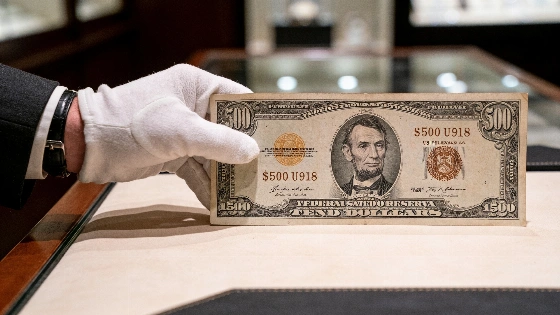
A 1918 $500 Federal Reserve Note from San Francisco, graded Choice Uncirculated 64, is set to be auctioned again with an estimated value up to $175,000, offering collectors a rare chance to acquire a top-grade large-denomination US banknote
Most Americans have never seen, let alone handled, a $500 bill. Yet one of the finest surviving examples of the United States' first high-denomination Federal Reserve Notes is now returning to the auction market. The 1918 $500 Federal Reserve Note from the San Francisco district, graded Choice Uncirculated 64 by PMG, is expected to fetch between $125,000 and $175,000, according to Stack's Bowers Galleries. This note stands out as the only example from the San Francisco Federal Reserve District to achieve this grade in the current PMG Population Report, making it a significant opportunity for advanced collectors.
The note last appeared at auction in November 2023, where it realized $150,000. Its reappearance highlights the scarcity of high-grade large-size US currency, especially for denominations that were never widely used by the public. Most $500 notes circulated primarily among banks and large financial institutions, with few surviving in pristine condition.
Origins and Purpose of the 1918 $500 Note
The Series of 1918 marked a turning point in US currency history, introducing $500, $1,000, $5,000, and $10,000 denominations to support large interbank transactions. Prior to this, Federal Reserve Notes were issued in denominations up to $100. The Bureau of Engraving and Printing produced these high-value notes to facilitate major financial transfers, not everyday consumer use. While popular culture sometimes associates large bills with gambling or illicit activity, their primary function was to serve the needs of banks and commercial institutions.
In 1929, the US government reduced the size of all Federal Reserve Notes to the modern format, making the original large-size notes-measuring 7.375 by 3.125 inches-distinctive in both appearance and presence. The 1918 $500 note's imposing dimensions and intricate design set it apart from later issues.
Design and Historical Imagery
The face of the 1918 $500 note features Chief Justice John Marshall, who served from 1801 to 1835 and played a pivotal role in establishing the Supreme Court's authority. His engraved portrait is flanked by the signatures of Treasurer John Burke and Treasury Secretary Carter Glass. Four large "500" counters anchor the corners, while ornate cartouches and seals identify the note's Federal Reserve origin and its San Francisco district-marked by the "12-L" indicators and a blue Treasury seal.
The reverse of the note transforms it into a miniature work of historical art. Its central vignette is adapted from William Henry Powell's painting "Discovery of the Mississippi by De Soto," which hangs in the US Capitol Rotunda. The scene depicts Spanish explorer Hernando de Soto's 1541 arrival at the Mississippi River, surrounded by soldiers, Native Americans, and religious figures. The composition reflects both the drama and complexity of 19th-century interpretations of exploration and conquest, with visual elements that evoke both power and conflict.
Condition and Collector Value
Condition is a critical factor in the value of historical banknotes. According to Stack's Bowers, this San Francisco note is the sole example graded Choice Uncirculated 64 for its district, with none finer listed in the PMG census. Only one other district-the Atlanta issue-has a comparable note at this grade, which sold for $111,000 in March 2020. The rarity of such high-grade examples means collectors may wait years for another opportunity to acquire a note of this caliber.
Large-denomination notes like the 1918 $500 were typically handled by banks, often showing signs of wear from vault storage and counting. Uncirculated examples are especially rare, combining technical quality, visual appeal, and historical significance. The San Francisco note's sharp margins, bright paper, and crisp detail contributed to its top-tier grade.
Key Specifications and Auction Context
The 1918 $500 Federal Reserve Note from San Francisco (Friedberg 1132-L) features the following specifications: denomination $500, large-size format, blue Treasury seal, signatures of John Burke and Carter Glass, and a reverse design based on Powell's "Discovery of the Mississippi by De Soto." Its dimensions are approximately 7.375 by 3.125 inches. The note's previous auction result was $150,000 in November 2023, with the current estimate ranging from $125,000 to $175,000.
For collectors, the combination of rarity, condition, and historical artistry makes this note a trophy piece. Its reappearance at auction underscores the enduring appeal of large-size US currency and the challenges of acquiring top-grade examples.
Facts and Data
The 1918 $500 Federal Reserve Note from San Francisco is graded Choice Uncirculated 64 by PMG, with only one example at this grade for the district and none finer. The note last sold for $150,000 in November 2023, and Stack's Bowers Galleries currently estimates its value at $125,000 to $175,000. Only one other comparable note from a different district (Atlanta) has achieved a similar grade, selling for $111,000 in March 2020.
While the $500 denomination is no longer issued or used in everyday transactions, its legacy endures among collectors and historians. The Series of 1918 notes represent a period when the US financial system relied on large-denomination currency for interbank settlements and major commercial transfers. Today, surviving examples-especially in uncirculated condition-offer a tangible link to the evolution of American money and the changing needs of the financial system over the past century.