
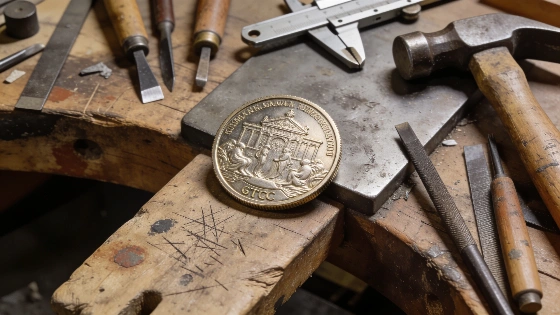
The ANA's 2026 World's Fair of Money medal, designed by Jamie Franki and Heidi Wastweet, unites numismatic history with Pittsburgh's industrial past in a detailed, collaborative creation that has already sold out its first run
The American Numismatic Association (ANA) has unveiled its 2026 World's Fair of Money medal, a project that brings together two of the most respected names in medallic art: Jamie Franki and Heidi Wastweet. Their collaboration delivers a design that not only honors the history of the Lincoln cent but also pays tribute to Pittsburgh's iconic steel industry, the host city for the 2026 convention. The medal's initial run of 100 pieces sold out rapidly, prompting a second production round to meet collector demand.
Franki, an emeritus professor of illustration at the University of North Carolina at Charlotte, is recognized in the numismatic world for his work on the 2005 Westward Journey nickel and the Jefferson portrait introduced in 2006. Wastweet, a leading American sculptor specializing in medals and bas relief, is known for her Liberty-themed works and her recent reinterpretation of the 1776 Libertas Americana medal for the Medal Collectors of America. Their partnership, which began in 2013 through the American Medallic Sculpture Association, has produced several notable medals, but both artists describe the 2026 ANA medal as their most ambitious effort to date.
Designing a Medal for a Changing Era
The 2026 medal's design process was shaped by the intersection of numismatic history and Pittsburgh's industrial identity. Franki explored the end of the 1-cent coin's production for circulation in 2025, the wartime steel cents of the 1940s, and the city's reputation as "Steel City." Drawing inspiration from Victor David Brenner's original Lincoln cent obverse and Frank Gasparro's reverse, Franki created a composition that features steelworkers constructing a monumental Lincoln portrait from welded and riveted metal, with Pittsburgh's skyline emerging in the background. The reverse side incorporates the historic Duquesne Incline, a nod to the city's engineering heritage, replacing the Lincoln Memorial in Gasparro's original design.
Wastweet, one of the few medallic artists still working with hand-sculpted plaster models, translated Franki's intricate drawings into bas-relief. She focused on creating the illusion of depth within the constraints of medal production, ensuring that foreground elements like scaffolding and funicular cars stood out while background details receded. The technical challenge was to preserve clarity and boldness, distilling Franki's detailed sketches into a form that would survive the reduction process required for minting.
Collaboration and Technical Mastery
The partnership between Franki and Wastweet is built on mutual respect and complementary skills. Franki brings conceptual energy and a willingness to explore multiple design directions, while Wastweet applies her technical expertise to ensure that ambitious ideas can be realized in metal. Their workflow involves extensive back-and-forth, with Wastweet identifying potential production issues and proposing solutions rather than vetoing creative risks. This approach has allowed them to push the boundaries of what is possible in modern medallic art.
For collectors, the 2026 ANA medal stands out not only for its artistic merit but also for its historical resonance. The design references the transition away from the circulating Lincoln cent, a coin that has been a fixture of American currency since 1909, and connects it to Pittsburgh's legacy as a center of steel production. The medal's popularity is reflected in the rapid sellout of the first batch, with pre-orders for the second run open until August 28 and shipping scheduled for October. Franki and Wastweet will discuss their creative process at a Money Talks session during the convention on August 27.
Numismatic Context and Collector Demand
The ANA's decision to commission a medal that bridges numismatic and local history follows a broader trend in commemorative coin and medal design. Recent years have seen strong collector interest in pieces that combine technical innovation with historical storytelling. For example, the upcoming auction of a 1939 Proof Walking Liberty Half Dollar, which set a grading record, highlights the ongoing appeal of U.S. coinage that captures pivotal moments in American history. (A record-setting 1939 Proof Walking Liberty Half Dollar will headline a major 2026 auction.)
According to the ANA, the 2026 medal's first run of 100 pieces sold out within days of its announcement. The second run, available for pre-order until August 28, is expected to ship in October. The medal's production timeline aligns with the anticipated end of the Lincoln cent's circulation, marking a symbolic transition in U.S. coinage. Collectors interested in the new medal are encouraged to act promptly, as demand has consistently outpaced supply for recent ANA convention issues.
Medallic art occupies a unique space in the world of coins and currency. Unlike circulating coins, medals are not intended for everyday transactions but serve as commemorative objects that capture historical events, institutional milestones, or artistic achievements. The process of designing and producing a medal involves balancing artistic vision with technical constraints, such as relief depth, metal flow, and the limitations of minting equipment. Successful collaborations between designers and sculptors, like that of Franki and Wastweet, demonstrate how creative partnerships can overcome these challenges to produce works that resonate with both collectors and the broader public.