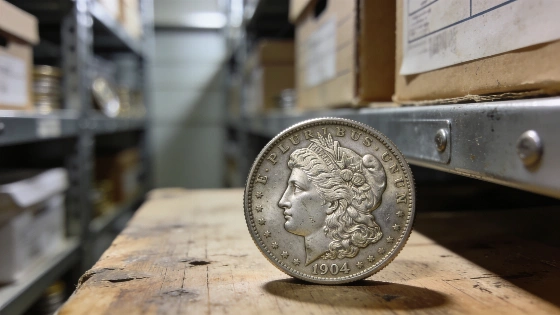
The 1904 Morgan Dollar was the last of its kind from Philadelphia before a 17-year halt in US silver dollar production. Its survival through mass melting and limited releases has made high-grade examples rare and historically significant
In 1904, the Philadelphia Mint produced what would become the final Morgan Dollar of its original era, closing a chapter in US coinage that would not reopen for nearly two decades. That year, the Mint struck 2.2 million Morgan Dollars in January, but output quickly dwindled-just 66,000 more coins followed in February, and none were made in March, April, or May. A final burst of 522,000 coins in June brought the total to 2,788,000 before production stopped entirely. No one at the time could have predicted that the presses would remain silent for 17 years, nor that the fate of these coins would be shaped by global events and sweeping changes in US silver policy.
Production Stops and the Silver Meltdown
The Morgan Dollar, first authorized by the Bland-Allison Act of 1878, had become a fixture of US currency. By 1904, however, the Mint's silver reserves were nearly exhausted, forcing a halt in production. The United States would not strike another silver dollar until 1921, when the Morgan Dollar briefly returned before being replaced by the Peace Dollar. The intervening years saw the US government's vast stockpile of silver dollars become a strategic asset during World War I. In 1918, Congress passed the Pittman Act, authorizing the melting of up to 350 million silver dollars to supply silver to Britain and to support subsidiary coinage. Ultimately, 270,232,722 silver dollars were melted under this law, with records indicating that around 200 million ounces of silver were shipped to Britain alone. The lack of detailed records means it is impossible to know exactly how many 1904 Morgan Dollars were destroyed, but numismatic research suggests that a significant portion of the original mintage did not survive.
Unlike some other Morgan Dollar dates that later flooded the market when Treasury vaults were emptied in the 1950s and 1960s, the 1904 Philadelphia issue never appeared in large quantities. Only a handful of bags surfaced during the Treasury releases, and a single bag was reported in 1979, mostly containing coins of average uncirculated quality. As a result, while circulated 1904 Morgan Dollars are accessible to collectors, high-grade Mint State coins-especially those with prooflike or deep mirror prooflike surfaces-are rare and command strong premiums at auction.
Condition Rarity and Market Impact
The rarity of top-grade 1904 Morgan Dollars is reflected in third-party grading data. According to the August 2026 PCGS Population Report, there have been 8,795 Mint State grading events for this date, but only 19 at MS66+ and a single coin at MS67. Prooflike and deep mirror prooflike examples are even scarcer, with just 33 prooflike and two DMPL grading events recorded. Notable coins, such as the Jack Lee MS65DMPL and other high-grade prooflike pieces, have achieved auction prices exceeding $50,000, underscoring the intense demand among advanced collectors.
Historical price data shows how perceptions of rarity have evolved. In the late 1940s and early 1950s, uncirculated 1904 Morgan Dollars were advertised for as little as $3 to $3.50, reflecting a market that had not yet experienced the impact of Treasury releases or the rise of registry-set collecting. Today, the difference in value between a typical uncirculated coin and a true gem is dramatic, with the finest examples setting records as condition rarities.
Design, Specifications, and Historical Context
The 1904 Morgan Dollar features the classic design by George T. Morgan, with Liberty's left-facing portrait on the obverse and a powerful eagle with outstretched wings on the reverse. The coin is composed of 90% silver and 10% copper, weighs 26.73 grams, and measures 38.10 mm in diameter. The Philadelphia issue carries no mintmark and was struck as a business strike. These specifications are confirmed by the US Mint and PCGS.
For collectors and historians, the 1904 Morgan Dollar stands at a crossroads. It marks the end of the original Morgan Dollar era (1878-1904), survived the mass melting of the Pittman Act, and was never released in the quantities that made other dates common in high grades. Its story is intertwined with broader shifts in US monetary policy and international finance, as the silver dollar's role changed in response to war, legislation, and evolving economic needs.
Most collectors never saw large quantities of 1904 Morgan Dollars released from government storage, a fact that distinguishes this date from others that became more available after the Treasury's mass distributions. The rarity of high-grade examples has only increased as registry collecting and third-party grading have become central to the US coin market. For a deeper look at how scarcity and preservation standards shape the value of rare US coins, see this analysis of a record-setting Walking Liberty Half Dollar auction: how top-graded coins can redefine rarity in the collector market.
Understanding the Morgan Dollar's Legacy
The 1904 Morgan Dollar's significance goes beyond its mintage figure. It represents the last Philadelphia Morgan Dollar before a 17-year production gap, survived a period when over 270 million silver dollars were melted, and remains elusive in top condition. For collectors, a circulated example offers a tangible link to the end of the first Morgan Dollar era, while a gem or prooflike coin is a true prize. The coin's journey-from routine production to historical rarity-reflects the unpredictable forces that shape the fate of physical currency in the US and beyond.
The Morgan Dollar's story also highlights the impact of government policy on coinage. The Pittman Act not only authorized the destruction of millions of silver dollars but also required the US Treasury to purchase new domestic silver and replace the melted coins. This led to the brief revival of the Morgan Dollar in 1921, followed by the introduction of the Peace Dollar, which symbolized a new era in American coin design. The 1904 issue thus serves as a reminder of how legislative decisions, international events, and collector demand can converge to transform an ordinary coin into a historical artifact.