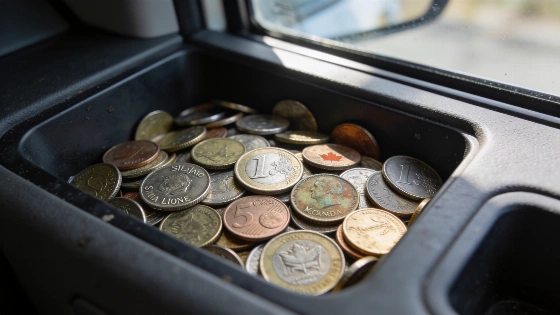
Coins from Sierra Leone, Jamaica, Colombia, Mexico, Canada, and Germany found in loose change offer a tangible link to global histories, political shifts, and cultural identities, highlighting how everyday money connects us to distant places and past events
Loose change often goes unnoticed, but a closer look can reveal a surprising diversity of coins from around the world. Over the course of a year, a small compartment in a car can accumulate not just local currency, but also coins from distant countries-each carrying its own story. When sorting through a collection of coins gathered from daily transactions, it is not uncommon to find pieces from multiple continents, reflecting the movement of people and money across borders. Among a recent assortment, coins from Sierra Leone, Jamaica, Colombia, Mexico, Canada, and Germany stood out, each offering a window into the history and culture of its origin.
While some coins, such as Canadian cents with their distinctive maple leaf, are easily recognized, others require closer inspection. The presence of foreign coins in everyday change is a reminder of how travel, migration, and commerce circulate currency far beyond its intended borders. For collectors and casual observers alike, these coins are more than just metal-they are artifacts of political change, economic development, and cultural identity.
Sierra Leone and Jamaica: Symbols of Freedom and Change
Sierra Leone's coinage reflects a complex history shaped by the abolition of slavery and colonial rule. The country was established as a settlement for freed slaves in the late 18th century, with Freetown founded in 1787 as a refuge for those liberated from the British Empire and the United States. The name Sierra Leone, meaning "lion mountains," dates back to Portuguese explorers in the 16th century. Modern coins often feature the words FREEDOM and JUSTICE, echoing the nation's founding ideals. The 1974 penny, for example, displays Sir Milton Margai, the first prime minister, on one side and a palm sprig-an ancient symbol of victory and peace-on the other. The lion motif, present since 1791, continues to represent vigilance and guardianship.
Jamaica's coins also chart a path from colonial governance to independence. The 1959 cent, minted under British rule, features Queen Elizabeth II and a reverse design with St. George's Cross and five pineapples, alongside the Latin motto INDUS UTERQUE SERVIET UNI ("Both Indies shall serve one"). After independence in 1962, Jamaica retained the Queen's portrait but adopted a new motto: "Out of Many, One People." The evolution of these designs mirrors the island's transition from colony to Commonwealth nation, with coins serving as markers of political and social change.
Colombia and Mexico: Heritage and Identity in Coinage
Colombia's coins reflect a blend of indigenous, European, and African influences. The 5-centavo coin, for instance, features a prominent Phrygian cap-a symbol of liberty with roots in ancient Rome and the French Revolution-surrounded by wreaths. On the reverse, coffee bean sprigs flank the denomination, and a cornucopia appears above, highlighting the country's agricultural wealth. Colombia's economy remains heavily reliant on coffee, oil, bananas, and emeralds, while its coinage documents a history marked by political upheaval and cultural fusion.
Mexico's coinage is renowned for its expressive imagery and historical continuity. The Mexican real, used from the 16th to 19th centuries, was the world's first truly global coin and circulated widely in the Americas and beyond. The phrase "pieces of eight" refers to the practice of dividing the real into eight segments for smaller transactions. Even after the Coinage Act of 1857 ended its legal tender status in the United States, Mexican coins continued to influence regional currency systems. The 1946 20 centavos coin features the Pyramid of the Sun at Teotihuacan, flanked by volcanoes and topped with a Phrygian cap, while the obverse displays a national eagle. These motifs underscore Mexico's emphasis on sovereignty and freedom, drawing on both indigenous and classical traditions.
Canada and Germany: Continuity and Transformation
Canada's numismatic history is shaped by its ties to Britain and its vast natural landscape. The first Canadian cent, minted in 1858, was a large provincial coin, and the maple leaf has remained a central symbol ever since, representing unity, strength, and endurance. Canadian coins continue to feature the reigning British monarch on the obverse, reflecting the country's ongoing relationship with the Commonwealth. The Royal Canadian Mint is known for its nature-themed coins, many of which are produced in full color for collectors, but circulating coins maintain traditional designs.
Germany's coinage has evolved through periods of division and reunification. From the post-war era until 1990, West and East Germany issued separate coins, but since reunification, a single currency has represented the nation. The 10 pfennig coin, minted in large quantities from the 1950s to the 1990s, is light and brass-colored, often mistaken for a dime or penny. Its obverse features the German Federal Eagle and the inscription BUNDESREPUBLIK DEUTSCHLAND, while the reverse displays oak leaves and acorns-symbols of national strength. In 2002, the 10 pfennig was replaced by the 10-cent euro coin, marking Germany's integration into the euro area. For collectors interested in the broader context of Latin American and European coinage, auctions such as those highlighted in this feature on rare Latin American and Spanish coins offer insight into the global reach and historical significance of these currencies.
Facts and Figures: Coin Circulation and Exchange
According to the Royal Canadian Mint, over 35 billion Canadian coins have been produced since 1908, with the maple leaf cent remaining in circulation until its withdrawal in 2012. In Germany, the 10 pfennig coin was issued in more than 8 billion pieces between 1950 and 2001 before the euro transition. Mexico's 20 centavos coin, first minted in 1943, was widely used until the introduction of new denominations in the late 20th century. Jamaica's coins underwent significant design changes after independence, while Sierra Leone's coinage has reflected multiple political regimes since 1961. Colombia's centavo coins continue to circulate, though inflation and currency reforms have reduced their everyday use.
Each coin found in everyday change is a testament to the journeys of people and money across borders. Whether brought by travelers, migrants, or through international trade, these small objects connect individuals to distant histories and evolving national identities.
Coin design is more than an artistic choice; it is a deliberate expression of national values, political transitions, and economic priorities. Motifs such as the Phrygian cap, the lion, or the maple leaf are chosen to communicate ideals like liberty, vigilance, or unity. Changes in coin imagery often coincide with major historical events-independence, regime change, or monetary reform-making coins a valuable resource for understanding how countries present themselves to the world and to their own citizens. The study of coins, or numismatics, thus offers a unique perspective on the intersection of money, history, and identity.