
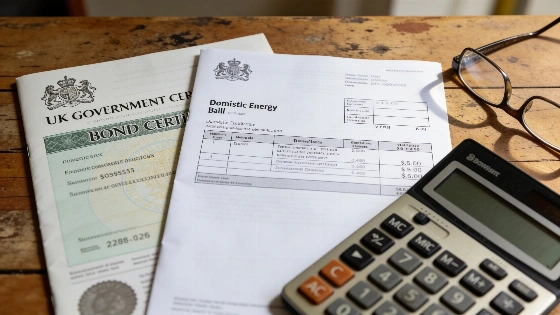
UK energy bills are set to climb sharply in early 2027 but any large-scale government support risks destabilising bond markets already under strain from high debt and volatile rates
As the UK heads into another winter of rising energy costs, the government faces a difficult choice: step in to help households manage higher bills, or risk unsettling bond markets that are already under pressure. The turmoil of 2022-when the Energy Price Guarantee and unfunded tax cuts sent gilt yields sharply higher-still shapes how policymakers approach these decisions. The Bank of England is watching closely, aware that fiscal moves can quickly affect inflation, the pound, and overall market stability.
Calls for government action are growing. Ofgem has set the October-December 2026 price cap at £1,723 for a typical dual-fuel household, up 4% due to higher wholesale gas prices. The cap includes an electricity unit rate of 26.32p/kWh and a gas rate of 7.97p/kWh, with daily standing charges of 54.83p for electricity and 29.68p for gas. Looking ahead, forecasts for January-March 2027 point to further increases. Cornwall Insight initially estimated £1,872, but major suppliers now expect bills above £2,000: E.ON and Sainsbury's Energy project £2,027, EDF £2,046, and British Gas £2,065-a 19% jump from October. These figures do not yet account for recent supply shocks, such as the Saudi pipeline closure and Brent crude rising above $107 per barrel. Ofgem's markets director has noted that high international gas prices continue to drive UK costs, and welcomed the government's temporary VAT cut on electricity, which runs from 1 October 2026 to 31 March 2027, as set out in official legislation.
Bond market fragility
Any major government support would come at a time when public finances are already stretched. The VAT cut on electricity, costing about £850 million over six months, is due to end in March 2027. Anything larger would require significant new borrowing. UK ten-year gilt yields hit a 19-year high of 5.378% in September 2026, and 30-year yields reached 5.948%, according to Reuters. The Debt Management Office recently sold £4.25 billion of 30-year government debt at a yield of 5.8168%, the highest since the DMO was set up in 1998. The Bank of England is monitoring these moves, as higher yields can tighten financial conditions and affect the wider economy.
The events of 2022 are still fresh. When the Energy Price Guarantee was announced in September 2022, capping annual bills at £2,500 for two years, the Institute for Fiscal Studies estimated the first-year cost at £100 billion. Deutsche Bank put the combined cost of energy support and tax cuts at £179 billion. The Office for Budget Responsibility initially projected £24.8 billion for households and £18.4 billion for businesses. The surge in borrowing led to a sharp sell-off in gilts, forcing a quick policy reversal and a cutback of the guarantee to six months. Falling wholesale prices later limited the final cost to about £27 billion, but the episode shook market confidence and sent the pound sharply lower against the dollar and euro.
Political and economic trade-offs
Today, the backdrop is even tougher. Gilt issuance is at record highs, the Bank of England is shrinking its balance sheet, and national debt is close to 95% of GDP. Goldman Sachs warns that relying on more borrowing for new support would likely push up the gilt risk premium, repeating the same market reaction as in 2022-only faster and from a weaker position. The International Monetary Fund has also warned that countries with high debt, like the UK, are more exposed to interest rate shocks and currency swings if they do not keep fiscal discipline.
While current energy bills are well below the 2022 peak, the market's ability to absorb new fiscal shocks has weakened. The October 2026 cap of £1,723 is less than half the £3,549 cap overridden by the 2022 guarantee, but the government's room to manoeuvre is now much smaller. Even modest support could increase volatility in bond yields, raising borrowing costs for the government and, in turn, for households and businesses. The Bank of England's Monetary Policy Committee has repeatedly stressed the need to anchor inflation expectations and keep market confidence in the government's fiscal plans.
Data and market signals
Ofgem's October-December 2026 price cap is £1,723, up 4% from the previous quarter. Supplier forecasts for January-March 2027 average £2,046, a 19% increase. UK ten-year gilt yields reached 5.378% in September 2026, the highest since 2007, and 30-year yields are near 5.948%. National debt is close to 95% of GDP, and the VAT cut on electricity ends in March 2027. The Bank for International Settlements has noted that rising sovereign yields in advanced economies can spill over into currency markets, increasing volatility and risk premiums for local assets.
Policy caution in a volatile environment
For policymakers, the message is clear: the UK's fiscal and market position leaves little room for large-scale interventions. The risk is not just the cost of support, but how quickly borrowing needs could rise, potentially triggering another bond market sell-off. With the Bank of England reducing its holdings of government debt and global energy prices still volatile, there is little margin for error.
When the government borrows more, it issues additional gilts (UK government bonds) to raise funds. If investors lose confidence in the government's ability to manage its debt or worry about inflation, they may demand higher yields. This raises borrowing costs for the government and can lead to higher interest rates for businesses and consumers. In extreme cases, as in 2022, a sudden loss of confidence can force abrupt policy changes and unsettle financial markets. The Bank of England, the IMF, and the Bank for International Settlements all stress the need for credible fiscal and monetary policy to maintain currency stability and investor trust.