

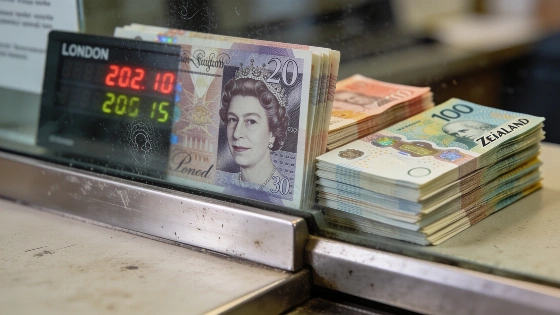
The British pound has slipped beneath its 200-day moving average versus the New Zealand dollar, with upcoming inflation expectations in New Zealand and diverging central bank policies shaping the outlook for the currency pair this week
The British pound has once again failed to break through the upper boundary of its year-long trading range against the New Zealand dollar, with the latest retreat pushing the pair below its 200-day moving average. This technical shift has turned the medium-term outlook more negative for sterling, as the exchange rate now sits closer to the middle of its established band rather than challenging new highs.
At the start of the week, the Pound-to-New Zealand Dollar (GBP/NZD) spot rate was recorded at 2.28890, notably below the 200-day moving average of 2.30043. The moving average, which had provided some support through the first half of the year, has now flattened and begun to decline. This change removes a layer of structural support for sterling, leaving the currency exposed to further downside unless it can reclaim this technical level.
Inflation Expectations and Central Bank Divergence
The main event risk for the week comes from New Zealand, where the Reserve Bank of New Zealand (RBNZ) will release its quarterly survey of inflation expectations on Thursday. The two-year inflation expectation was last measured at 2.53%, and the survey has gained importance as the RBNZ continues its tightening cycle. Market participants are watching closely to see whether expectations for future inflation will rise further, especially given recent volatility in oil prices and a headline inflation rate that has climbed back to 4.1%.
According to Westpac, the RBNZ is particularly focused on whether higher oil prices are feeding into broader pricing behavior. While expectations remain within the central bank's 1-3% target band, the upward trajectory since 2025 is a concern. A stronger-than-expected reading could reinforce the case for further rate hikes, supporting the New Zealand dollar. Conversely, a softer result would suggest that oil-driven inflation is not yet translating into persistent price pressures, potentially giving the RBNZ room to pause or slow its tightening cycle.
Technical Barriers and Support Levels
For sterling, the immediate challenge is to recover the 200-day moving average at 2.30043. Above this, resistance is concentrated between 2.3050 and 2.3100, an area shaped by the sharp decline in late July. The upper boundary of the range, at 2.35440, has now rejected the pair three times in the past year-most recently in July-highlighting the strength of this ceiling. On the downside, initial support is found at the early August low of 2.2830, followed by June's spike low near 2.2450, and the established range floor at 2.24000.
Momentum indicators such as the Relative Strength Index (RSI) suggest that while the pace of the recent decline is slowing, overall sentiment remains weak. The RSI stands at 41.57, just above its average, indicating that the market is not yet oversold but lacks the strength for a decisive rebound. The forecast for the week points to a likely range between 2.2830 and 2.30043, with sterling needing to reclaim the moving average before any more constructive scenario can be considered.
Policy Gap Widens as UK Data Looms
The broader context for the currency pair is shaped by diverging central bank policies. The Reserve Bank of New Zealand is actively raising interest rates in response to rising inflation expectations, while the Bank of England has held rates steady. This policy gap has widened since July, making the New Zealand dollar relatively more attractive to investors seeking higher returns. Unless UK economic data surprises to the upside, this divergence is likely to persist.
On Thursday, the UK will also release its second-quarter GDP figures, with consensus forecasts pointing to 0.4% growth-slightly above the 0.3% assumed by the Bank of England's Monetary Policy Committee. However, unless the data significantly exceeds expectations, it is unlikely to shift the balance in sterling's favor.
Recent developments in oil prices have further complicated the outlook. Because much of New Zealand's inflation pressure is linked to energy costs, any escalation in global oil markets could reinforce the RBNZ's tightening stance and strengthen the New Zealand dollar. Conversely, a de-escalation and drop in oil prices would ease inflation concerns and potentially give sterling an opportunity to recover lost ground.
For a broader perspective on how yield spreads and central bank policy are influencing sterling's performance against other major currencies, see this analysis of recent moves in the pound against the euro and US dollar.
Range-Bound Outlook Remains
Despite the recent reversal, the GBP/NZD pair remains within the 2.24000 to 2.35440 range that has defined its trading for the past year. The July decline has returned the pair to the middle of this band, rather than establishing a new trend. For those with New Zealand dollar payment needs, the current level sits below the midpoint of the range, and the medium-term outlook remains neutral as long as the established floor and ceiling hold.
In the week ahead, the focus will remain on inflation expectations in New Zealand and the ability of sterling to reclaim lost technical ground. Until a clear break occurs on either side of the range, the pair is likely to remain directionless, with event risk concentrated around central bank communications and key economic data releases.
Central banks play a critical role in shaping currency values through their policy decisions. When one central bank is raising interest rates while another holds steady, the resulting gap in expected returns can drive significant shifts in exchange rates. This mechanism is especially visible in currency pairs like GBP/NZD, where diverging inflation outlooks and policy responses create persistent pressure on one side of the pair. However, these dynamics can change quickly if economic data or global events alter the inflation or policy outlook, underscoring the importance of monitoring both technical and fundamental factors in currency markets.