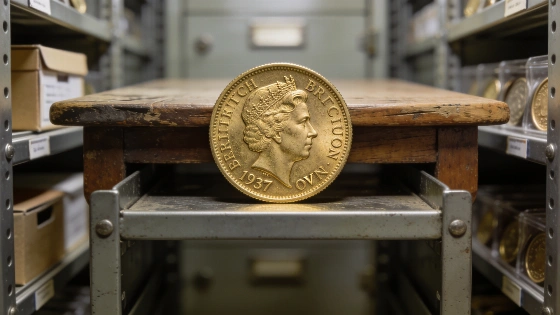
The 1937 Matte Proof gold sovereign is one of the rarest British coins, created for King George VI's coronation and never released for circulation. Its unique finish and limited production continue to attract collectors and drive auction premiums
The 1937 gold sovereign occupies a singular position in British coin history. Issued to mark the coronation of King George VI, it remains the only sovereign to bear his portrait, despite his 15-year reign. The Royal Mint produced this coin after the unexpected abdication of Edward VIII, making it both a symbol of royal transition and a technical milestone in British numismatics.
Unlike earlier sovereigns, the 1937 issue was not intended for everyday use. By the late 1930s, gold sovereigns had already disappeared from regular circulation in the United Kingdom. Instead, the Royal Mint included the coin in a special Proof Set, offered directly to collectors to commemorate the new monarch's accession. Only 5,501 sets were produced, with tradition suggesting that one was presented to King George VI himself. No gold sovereigns featuring his portrait were ever released for general circulation.
After the 1937 issue, British collectors faced a two-decade wait before the sovereign denomination returned. The next sovereign, issued in 1957, featured Queen Elizabeth II and introduced a new portrait by Mary Gillick. This gap further heightened the historical significance of the 1937 coin.
Technical Innovation and the Matte Proof Finish
Most 1937 sovereigns were struck with a brilliant Proof finish, characterized by highly reflective surfaces and sharp detail. However, a small number were produced with a distinctive Matte Proof finish. This unusual surface was not created for collectors, but to solve a practical problem: photographing coins for printed advertisements. The brilliant Proof coins reflected camera flashes, obscuring design details. To address this, the Royal Mint sandblasted a limited number of dies before striking, resulting in coins with a soft, light-absorbing texture that photographed clearly.
The Matte Proof finish was achieved by sandblasting the dies prior to striking, rather than treating the coins themselves. This method produced a subtle, non-reflective surface that set these coins apart from standard Proof issues. Because so few Matte Proof sovereigns were made, they quickly became one of the most sought-after rarities in modern British gold coinage.
Market Performance and Auction Results
Standard 1937 gold sovereigns already command strong demand among collectors, often trading at significant premiums over their gold content. According to auction data from Heritage Auctions, a 1937 gold sovereign graded PR64 purchased in 2014 outperformed the increase in the gold spot price by 25.5% over the following decade. However, the Matte Proof version is so rare that consistent price trends are difficult to establish. When these coins do appear at auction, they regularly achieve substantial premiums.
For example, a 1937 Matte Proof half sovereign graded PR64 by PCGS sold for $16,800 in New York in 2019. Five years later, the same coin achieved $38,400 at auction. The full sovereign Matte Proof is even rarer, with only three examples recognized by major grading services. In May 2024, a PCGS-graded PR64 Matte Proof sovereign sold for $72,000. These results reflect the combination of rarity, technical innovation, and royal history that drives collector interest.
Historical Context and Collector Appeal
The 1937 Matte Proof sovereigns are more than just rare coins; they are artifacts of a pivotal moment in British history. Their creation was prompted by the need to solve a photographic challenge, but the result was a unique experiment in minting technique. The coins' matte surfaces allowed for clear reproduction in print, while their limited production ensured enduring scarcity.
Collectors value these coins for their blend of historical significance, technical distinction, and visual appeal. With so few examples in existence, opportunities to acquire a Matte Proof 1937 sovereign are rare, and each auction appearance attracts international attention. The coins' status as both a product of royal transition and a technical innovation ensures their continued prominence in the world of British numismatics.
In 1937, the Royal Mint produced 5,501 gold Proof Sets for King George VI's coronation, but only a handful of Matte Proof sovereigns were created using sandblasted dies. The Matte Proof full sovereign is known in just three certified examples, with the most recent auction in May 2024 achieving a price of $72,000. These figures underscore the coin's rarity and the premium collectors are willing to pay for such a unique piece of British monetary history.
The distinction between brilliant and matte Proof finishes highlights the evolving relationship between coin production and technology. While brilliant Proofs were designed to showcase the artistry of the engraver, the Matte Proofs were a practical response to the challenges of early coin photography. Today, both types are valued by collectors, but the Matte Proof's scarcity and backstory give it a special place in the market. Understanding these differences helps explain why certain coins, even within the same issue, can command dramatically different values and collector interest.