
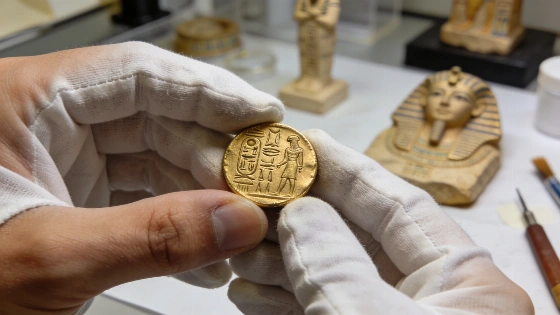
A rare gold coin from Nektanebo II's reign is the only known ancient currency to feature Egyptian hieroglyphics, reflecting a pivotal moment as Egypt's last native pharaoh fought to maintain independence before Persian and later Greek conquest
In the history of currency, Egypt stands out for its long resistance to coinage, even as neighboring empires embraced coins to project power and facilitate trade. This changed briefly in the 4th century BCE, when a single gold stater was issued under Pharaoh Nektanebo II. This coin is unique: it is the only known ancient coin to display Egyptian hieroglyphics, making it a rare artifact at the intersection of monetary innovation and political crisis.
Nektanebo II's Reign and the Coin's Origins
Nektanebo II ruled Egypt from 361 to 343 BCE, a period marked by instability and repeated threats from the Achaemenid Persian Empire. After seizing the throne from his uncle, Takhos, Nektanebo faced two major Persian invasions. He successfully repelled the first in 351/0 BCE, but a second campaign led by Artaxerxes III in 344/3 BCE forced him to flee south, ending native Egyptian rule. The gold stater was minted during this turbulent era, likely as part of efforts to pay Greek mercenaries defending the kingdom.
Design and Symbolism: Egyptian Identity in a Greek Monetary World
By the 4th century BCE, coinage was standard across the eastern Mediterranean, but Egypt's economy still relied on weighed bullion and state-controlled redistribution. Most coins circulating in Egypt were Greek in style or origin. Nektanebo's gold stater broke with this pattern. The obverse features a prancing horse, a motif familiar from Greek coinage but here possibly adapted to signal royal authority and appeal to Greek soldiers. The reverse is what sets the coin apart: it bears hieroglyphic symbols reading "nefer nebew," meaning "good gold." The design combines a pectoral necklace (nebew, gold) with a windpipe and heart (nefer, good), embedding traditional Egyptian concepts of value and legitimacy into a foreign monetary form.
Production, Rarity, and Purpose
The coin was struck at Memphis, Egypt's administrative center. Alongside the gold staters, the mint may have produced silver and possibly bronze coins, though evidence for the latter is limited. Only 42 examples of the gold stater are known today, produced from three die pairs, with about 20 held in private collections. This extreme rarity suggests the coins were not intended for broad circulation but served a targeted function-most likely to pay foreign mercenaries during the final years of resistance to Persian reconquest.
Facts and Data
The Nektanebo II gold stater measures 17 mm in diameter and weighs approximately 8.23 grams. Only 42 specimens are confirmed, with production dated to the late 4th century BCE, specifically during Nektanebo II's reign from 361 to 343 BCE. The coin's design is catalogued in numismatic references such as SNG Berry 1459 and SNG Copenhagen 1.
Legacy and Historical Significance
After Nektanebo II's defeat, Egypt fell under Persian control and, within a decade, was conquered by Alexander the Great. Under the Ptolemies and later the Romans, Egyptian motifs returned to coinage, but always filtered through Greek or imperial conventions. No later ruler issued coins with Egyptian hieroglyphs. The Nektanebo stater thus stands as a final assertion of pharaonic identity, condensing royal symbolism and cultural meaning into a small piece of gold at a moment of existential threat.
The use of hieroglyphs on a coin was more than decorative. In Egyptian culture, hieroglyphs were believed to carry intrinsic power, reinforcing the legitimacy and divine favor of the ruler. By placing these symbols on a coin intended for both Egyptian and foreign audiences, Nektanebo II attempted to bridge traditional authority with the practical needs of a mercenary army and a changing economic landscape.
Egypt's brief experiment with native coinage under Nektanebo II highlights the complex relationship between monetary forms, political power, and cultural identity. The gold stater remains a singular object in world numismatics-a coin that, for a fleeting moment, spoke in the language of the pharaohs as Egypt's independence slipped away.