

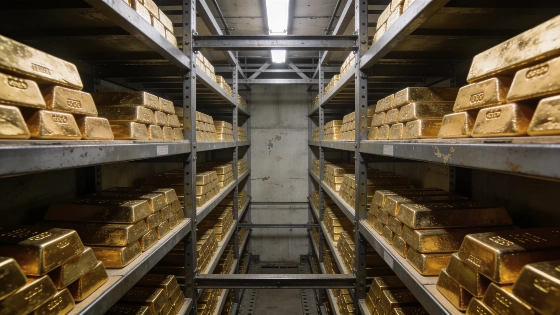
Amid record gold prices and global instability, the Netherlands has shifted a quarter of its overseas gold reserves from North America to London, aiming for faster liquidity and stronger crisis readiness
When gold soared past $4,400 an ounce and the world's shipping lanes bristled with risk, De Nederlandsche Bank (DNB) made a move that cut through the noise: it shifted 86 tonnes of its gold reserves out of North America and into London's vaults. This was not a routine reshuffle. It was a calculated response to a world where access to physical gold-fast-could mean the difference between stability and scramble.
Central banks rarely telegraph their reserve strategies in real time. Yet DNB's operation, executed between March and August 2026, was confirmed as gold's rally accelerated and geopolitical threats multiplied. The Dutch central bank's message was clear: in a crisis, gold locked away in distant vaults is less useful than gold ready to trade at the heart of the global bullion market.
Why London Became the New Gold Hub
Before the transfer, the Netherlands kept 313 tonnes of gold in New York and Ottawa. By August, 86 tonnes-over a quarter of that total-had been redirected to London. But the mechanics were more complex than a simple airlift. DNB sold 59 tonnes of gold in New York, then bought London Good Delivery bars in the UK. Another 27 tonnes were physically moved from North America to the DNB Cash Centre in Zeist, with a matching amount sent from Zeist to London. This avoided costly melting and recasting, while keeping the total Dutch gold reserve unchanged at 612.4 tonnes, valued at €72.2 billion at the end of 2025.
London's appeal is not just about security. The Bank of England sits at the center of the world's largest physical gold market, where ownership can change hands instantly without moving a single bar. Gold that meets London Good Delivery standards is immediately tradable, a crucial advantage if financial markets seize up. The Bank of England's vaults hold around 400,000 bars, most belonging to governments and central banks. For DNB, this means liquidity on demand-an asset that can be mobilized at a moment's notice.
Reserves Rebalanced: The New Dutch Gold Map
The operation left the Netherlands with a far more balanced reserve profile. London now holds 32.1% of Dutch gold, up from 18.1%. Zeist remains steady at 30.8%. New York and Ottawa, once dominant, now each account for 18.5%. DNB did not abandon North America, but it sharply reduced its exposure there, spreading risk and increasing access to the world's most liquid gold market.
Governor Olaf Sleijpen described the move as a step to "improve the tradability" of Dutch gold. The bank's public statements emphasized resilience and preparedness, calling gold an "anchor of trust" that carries no counterparty risk. In plain terms: gold is only as useful as its accessibility. In a severe crisis, bullion that can be traded instantly is worth more than bars locked away under another country's jurisdiction.
France's Parallel Play and the Gold Rally
The Dutch are not alone in rethinking gold logistics. France's Banque de France recently replaced 129 tonnes of older, non-standard gold in New York with modern bars stored in Paris. That operation, completed between July 2025 and January 2026, generated a €12.8 billion capital gain thanks to accounting rules and surging prices. Unlike the Dutch, the French brought their gold home, prioritizing control over liquidity. Both moves, however, reflect a new central-bank consensus: the condition, location, and tradability of gold matter as much as the headline reserve total.
Gold's rally has been relentless. According to CNBC, the metal traded at $4,429.61 per ounce, up nearly 25% over the previous year. The surge has tracked persistent financial and geopolitical instability, including the ongoing U.S.-Iran conflict that continues to disrupt shipping through the Strait of Hormuz. In this environment, central banks are not just watching prices-they are actively repositioning reserves for maximum flexibility.
Central Banks Want Usable Gold, Not Just Gold
For investors, the Dutch operation is a signal that goes beyond numbers. DNB did not increase its gold holdings or liquidate reserves. Instead, it restructured its portfolio to ensure that, in a true emergency, a significant share of its gold could be traded instantly in London. France's reserve upgrade points in the same direction: central banks want gold that is not just secure, but usable. The days of treating bullion as a static asset are over. Now, the focus is on liquidity, compliance, and the ability to act when markets freeze.
These moves are not isolated. As reported earlier, the UK's own currency faces pressure from political and fiscal uncertainty, underscoring how quickly financial conditions can shift. In this climate, central banks are not waiting for the next crisis to test their reserves-they are preparing now, with an eye on both geography and market access.
For all the attention on gold's price, the real story is institutional behavior. Central banks are quietly rewriting the rules of reserve management, prioritizing liquidity and control over tradition. The Netherlands' decision to move 86 tonnes of gold to London is not just a technical adjustment-it is a strategic bet that, in a world of sudden shocks, the ability to act fast is the ultimate reserve asset. This is not about chasing price gains or making headlines. It is about ensuring that, when the system is under stress, the gold is exactly where it needs to be-and in a form that can be used without delay.
Gold's role as a reserve asset is shaped by more than its market value. The London Good Delivery standard, maintained by the London Bullion Market Association, defines the physical and chemical characteristics required for bars to be accepted in the world's most liquid market. Only gold that meets these standards can be traded instantly within the Bank of England's system. This technical compliance is not a bureaucratic detail-it is the key that unlocks immediate liquidity for central banks, allowing them to respond to crises without the delays and costs of recasting or transporting non-standard bullion.