
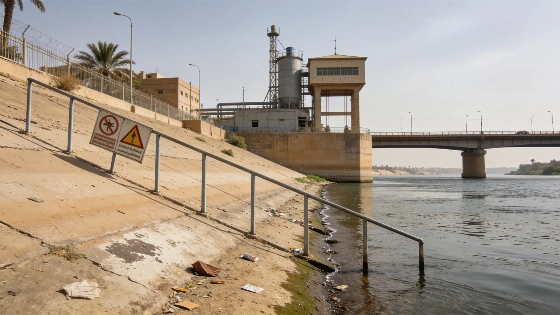
Unsupervised swimming in Assiut's Tabliya area has locals pressing officials for urgent safety steps. Families warn that without intervention, children and teenagers remain exposed to deadly risks along the Nile.
Every afternoon, the Tabliya stretch of the Nile in Assiut draws crowds of children and teenagers. They jump from the banks near the water company and the Hilali intersection, ignoring the current and the lack of supervision. Residents have watched this scene play out for months, fearing the next fatal accident. They want authorities to step in before another family suffers a loss.
So far, no official Egyptian media outlet has confirmed specific incidents or documented any formal response from local agencies. The claims about repeated drownings and alleged inaction remain rooted in community accounts, not verified records. Residents' demands for guards, fencing, or police orders at Tabliya have yet to yield any permanent changes. No official statistics on drownings in this area have surfaced, leaving families to rely on word of mouth and visible patterns of risk.
Locals have started questioning the water surfaces police and other agencies. They want a dedicated guard for Tabliya, similar to the security presence at the Assiut Barrage. Residents argue that a guard and clear warnings could cut the risk for young swimmers. These calls for accountability and risk management echo Egypt's broader economic pressures. The Central Bank of Egypt (CBE) has hiked its benchmark interest rate by 600 basis points since early 2023, trying to rein in inflation that topped 30 percent year-on-year. That squeeze has hit household budgets and public sector spending, including safety infrastructure.
Unsupervised swimming and its consequences have become a grim routine. Families carry the emotional and social fallout. The urgency is real: without action, preventable accidents will keep happening. In Beni-Shakir, another part of Assiut, the search for 19-year-old Islam Mohammed Taha dragged on for over eight days. River rescue teams and locals scoured the banks, battling strong currents and limited equipment, as detailed in a Masrawy report. The victim's uncle appealed directly to the governor for more rescue teams and better gear.
Tabliya is not the only danger zone. River safety lapses have triggered similar demands elsewhere in Egypt. Assigning a guard is seen as a quick fix, not a full solution. Residents also want a review of monitoring practices and a public campaign to warn young people about the Nile's dangers. The CBE's monetary moves, including currency devaluations, have shaped public sector budgets. Exchange rate swings drive up the cost of imported rescue equipment. The International Monetary Fund (IMF) notes that Egypt's foreign reserves have shifted in response to these pressures, affecting the government's ability to fund safety projects.
No official tally exists for Tabliya's accidents, but the steady drumbeat of community appeals signals a real problem. The lack of data makes it hard to measure the risk, yet the pattern of accidents and near-misses is impossible to ignore. In other regions, targeted local initiatives have sometimes made a dent, as previously reported. The Bank for International Settlements (BIS) points out that stable macroeconomic conditions and transparent fiscal planning are key for effective public safety investments. Both depend on central bank policy and currency management.
Warnings alone have not kept children out of the water. The push for a guard and tighter oversight comes from the limits of relying on signs or parental vigilance. Families cannot manage these risks alone. In 2018, a boat engine failure on the Nile in northern Sudan killed at least 22 schoolchildren and a hospital worker, according to Ahram Online. The current swept the boat away before help could arrive.
Responsibility for river safety cannot fall only on parents or informal community patrols. Children and teenagers face daily exposure to unguarded riverbanks. Residents' proposals are urgent and practical, but the lack of decisive action so far raises questions about official priorities. The CBE, IMF, and BIS all stress that lasting public safety improvements depend on macroeconomic stability and smart resource allocation.
Managing river safety in Egypt means local authorities, law enforcement, and community groups must coordinate. Assigning a guard at Tabliya is a targeted step, not a substitute for policy reform or ongoing public education. Effective strategies mix physical barriers and clear signage with community engagement and regular oversight. Consistent implementation remains the sticking point.